

Popular Crypto Currency and What People Use It For
If you have been hearing about popular crypto currency and wondering what is a crypto currency, you are not alone. There are thousands of coins out there, and sorting through them can feel overwhelming. This post is a plain-English look at how the major ones work, what they are used for, and where they differ. No fluff, just the facts as I have gathered them from the source material.
How Many Coins Are Out There
The scale of the market is hard to grasp. An overview reported more than 22,000 cryptocurrencies tracked across global exchanges, with the total market exceeding US$2.5 trillion. Another review counted almost 17,000. The gap comes from different data sources and time snapshots, but both numbers show how big this space has gotten. A separate educational overview picked a top ten based on market capitalization, though any such list is a snapshot, not a permanent ranking. Market values, classifications, and included projects change over time, so treat any ranking as a point in time, not a guarantee.
Coins, Tokens, and Altcoins
Before diving into specific coins, it helps to understand the crypto coin meaning. The basic split is between coins and tokens. A coin runs on its own blockchain - Bitcoin on Bitcoin, Ether on Ethereum, BNB on BNB Chain, SOL on Solana, ADA on Cardano, AVAX on Avalanche. A token uses another blockchain's infrastructure. Tether, Chainlink, Uniswap, and Polygon are examples of tokens that rely on other networks. The term altcoin covers anything that is not Bitcoin, and many altcoins try to fix perceived limits of Bitcoin around speed, supply, privacy, or fees.
Broad categories of crypto assets
- Currency tokens - meant to work as digital money or a medium of exchange
- Smart-contract and infrastructure tokens - pay for network resources or unlock apps
- Utility tokens - pay fees, unlock features, or reward participation
- Stablecoins - aim for steady value by referencing fiat, commodities, or algorithms
- Memecoins - built around internet memes, trends, or cultural references
- Security tokens - represent an interest in an asset or income stream
- Real-world asset tokens - represent ownership of physical or financial assets on a blockchain
Some projects blend several of these roles. A single token can serve as currency, pay network fees, give governance rights, and power apps within an ecosystem. If someone asks you what is this cryptocurrency, the honest answer is that it depends on which one - and what job it was built to do.
What Is Cryptocurrency and How It Works
At the core is the blockchain. A blockchain is a shared digital ledger where transactions are grouped into blocks and linked to earlier blocks. In a decentralized network, participants - not a single company - validate and verify transactions. If you have ever wanted to explain the blockchain in plain terms, the shared-ledger idea is the place to start. The how digital money works comes down to this: no central authority controls the ledger, and changes to validated records would be visible to the whole network.
Core features of blockchain systems
- Decentralized verification - miners or validators confirm transactions and earn rewards
- Shared records - once validated, transactions become part of a public ledger
- Tamper resistance - altering past blocks would require widespread agreement
- Programmable execution - smart contracts run automatically when conditions are met
- Shared operational rules - participants follow network rules without a single gatekeeper
Blockchain is not limited to currency. Ledgers can represent securities, real estate, or other assets and could reduce some forms of intermediation. The key point is that the tech is a tool, and the value depends on what people build on top of it. The how the ledger works idea is simple: records are hashed or encrypted, do not directly include personal information, and are accessible to network participants.
Consensus, Mining, and Staking
Different networks use different ways to agree on transaction history. Proof of work, or PoW, relies on computational effort. Bitcoin is the main example. Miners compete to solve puzzles, and successful miners get new coins and transaction fees. Proof of stake, or PoS, replaces mining with validators who stake native crypto as collateral. Validators check transactions and may receive rewards. Ethereum moved from PoW to PoS on September 15, 2022, in an event called the Merge. Cardano and Avalanche also use PoS. A 2024 FAQ grouped Ripple with PoS systems, though other descriptions of XRP focus on its cross-border payment role. Solana combines PoS with Proof of History, which timestamps incoming transactions to speed things up. The Merge was a pivotal moment for Ethereum, shifting its security model from energy-intensive computation to stake-based validation.
The distinction between PoW and PoS comes down to how much energy and hardware each system demands - and whether you believe decentralization or efficiency matters more.
Smart Contracts and Token Utility
Smart contracts are programs that execute automatically when predefined conditions are met. On networks like Ethereum, they power decentralized apps, lending, exchanges, NFTs, and games. A platform token typically pays network fees, compensates validators, unlocks features, or lets users participate in governance. Interoperability tokens like Cosmos' ATOM and Polkadot's DOT link separate blockchains together. Theta's TFuel is given as an example of a token that rewards network participation. The digital money, basically aspect of these tokens is that they are the fuel that keeps the network running.
Common functions of smart-contract tokens
- Paying transaction or network fees
- Compensating validators or nodes
- Purchasing computing or data resources
- Unlocking apps or features
- Participating in governance
- Incentivizing developers or content creators
- Connecting separate blockchains and projects
Smart-contract and utility tokens may overlap with currency tokens. The primary distinction is that a currency token is mainly intended for payments, while a platform token is often required to access, operate, or participate in a wider network. The code, user inputs, oracles, and external systems used by a contract can still create risks, even though the contract itself runs automatically. Maker, Uniswap, and Synthetix are cited as examples of DeFi services on Ethereum.
What Makes a Currency Useful
A historical analysis looked at whether crypto can do the three things money traditionally does. A unit of account means values can be expressed in a common measure, and an effective unit must be fungible, divisible, and countable. Cryptocurrencies generally satisfy these mathematical requirements. A medium of exchange means people can actually trade with it - the currency must be accessible, portable, accepted by buyers and sellers, and have sufficiently low transaction costs. A store of value means wealth holds up over time, and a currency used for savings must be durable, trusted, and relatively resistant to unexpected losses.
The analysis classified currencies into three forms: physical assets like gold and silver, fiat currencies issued by governments, and cryptocurrencies based on digital ledgers. Gold was described as strong as a long-term store of value but less convenient as a day-to-day medium of exchange. Fiat currencies depend on confidence in the issuing government. Cryptocurrencies remove a single government issuer but substitute other risks, including volatility, limited merchant acceptance, private-key loss, and uncertainty about whether a particular network will achieve broad adoption.
The 2017 take was that crypto had succeeded as a financial-market investment but had not yet won as a widely used currency. The design would need practical payment features, low costs, and a credible object of trust.
Bitcoin (BTC)
Bitcoin is the first cryptocurrency and still the largest by market cap. It is a decentralized peer-to-peer digital currency. Transactions are recorded on the Bitcoin blockchain without a bank or payment processor. The network is permissionless because anyone with an internet connection can use it. It is also characterized as censorship-resistant because no single controlling company can reverse or censor valid transactions under the network's rules. The source describes Bitcoin as highly resistant to seizure, though later debates about self-custody, legal authority, and private-key security qualify that description.
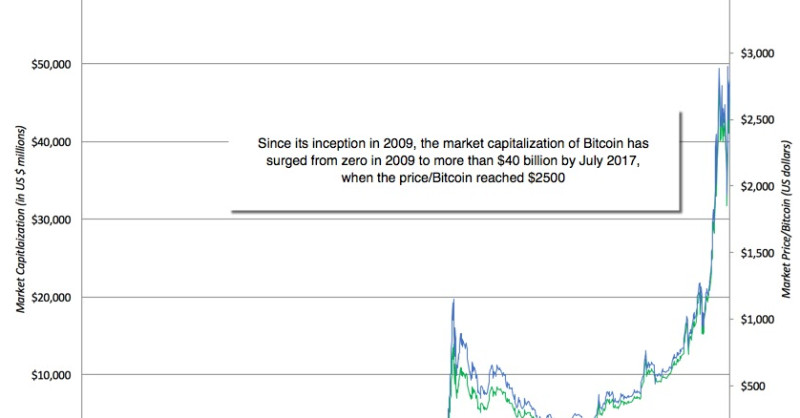
Bitcoin's origins date to a white paper published in 2008, and the first bitcoin was minted in 2009. By April 2024, Bitcoin had the largest market capitalization among cryptocurrencies, at approximately US$1.31 trillion. Bitcoin can be used wherever vendors accept it - the source names clothing from Ralph Lauren and Mitsubishi cars as examples of items reportedly purchased with Bitcoin. Bitcoin is also used as a store of value. Its supply is capped at 21 million coins, issued under a fixed schedule. The block reward is reduced through events known as Bitcoin halvings, which occur approximately every four years. The final bitcoin is expected to be mined around 2140.
Bitcoin's digital format allows it to be transferred globally without relying on the same correspondent-bank chain used by conventional international transfers. Cross-border Bitcoin transfers are often less expensive than international bank transfers. Institutional access expanded when eleven spot Bitcoin exchange-traded funds began trading in the United States in January 2024. BlackRock's IBIT held more than 800,000 BTC, representing over US$100 billion in assets under management and nearly 4% of Bitcoin's total supply. Strategy, formerly MicroStrategy, held more than 714,000 BTC on its corporate balance sheet. Bitcoin's price has historically risen faster than many national currencies, and the source presents this growth as a reason it can function as both a medium of exchange and a store of value, while also recognizing that accepting Bitcoin exposes merchants and holders to volatility.
Ethereum (ETH)
Ethereum was founded by Vitalik Buterin in 2015. It is an open-source blockchain that validates and records transactions and supports smart contracts. The network started with PoW and moved to PoS in September 2022. The Pectra upgrade, which the source says was fully rolled out in late 2025, improved account-abstraction features intended to make wallets easier to use and reduced transaction costs for Layer 2 scaling solutions. The source also describes Ethereum as a primary settlement layer for institutional real-world assets. Ether, or ETH, is Ethereum's native cryptocurrency. Unlike Bitcoin, Ether is not permanently capped, and a 2024 explanation said that an unlimited number could theoretically be created.
Major uses include deploying DApps, accessing DeFi services, lending, borrowing, trading, minting NFTs, playing blockchain games, creating smart contracts, settling institutional tokenized assets, and building applications that can interact with other networks. Named DeFi services on Ethereum include Maker, Uniswap, and Synthetix. Smart contracts make these applications possible by automatically executing agreed terms when conditions are met. They can reduce the need for an intermediary to administer an agreement, although the code, user inputs, oracles, and external systems used by a contract can still create risks.
Stablecoins and Why They Matter
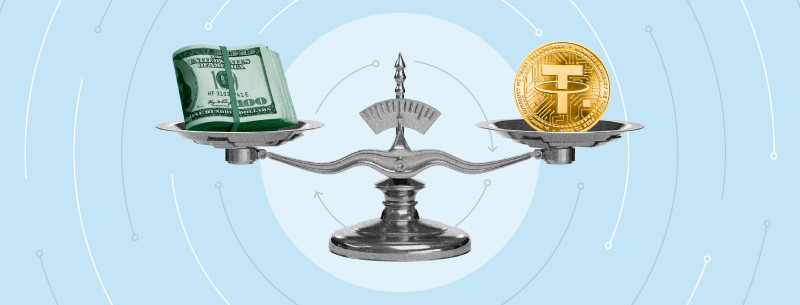
Stablecoins are digital currencies designed to hold a steady value. Most are pegged 1:1 to the U.S. dollar. They first appeared in 2014 to bridge the gap between blockchain functionality and day-to-day price stability. Think of them as a kind of dollars on a blockchain - programmable dollars that combine blockchain capabilities such as transparency, efficiency, transferability, and programmability with a design intended to reduce the price volatility that limits many cryptocurrencies as units of account. The question of coins that stay steady comes up a lot, and the answer is simple: they are stable-value tokens that track a separate reference asset such as the U.S. dollar, euro, gold, Treasury instrument, or basket of cryptoassets.
Types of stablecoins
- Fiat-pegged - tied 1:1 to currencies like the dollar or euro (Tether, USDC, Stasis Euro)
- Commodity-pegged - backed by gold or silver (PAX Gold, Tether Gold)
- Crypto-backed - held with other crypto, often overcollateralized (Dai)
- U.S. Treasury-backed - supported by Treasury securities and repos (USDY, USYC)
- Algorithmic - maintain value through supply adjustments (Ampleforth, Frax, USDe)
Stablecoins represent a large share of crypto transaction volume. A December 2024 analysis found that stablecoins represented more than two-thirds of the trillions of dollars worth of cryptocurrency transactions recorded in recent months. They are useful where people want blockchain access without BTC or ETH volatility. Their adoption varies by region, depending on banking access, currency stability, and regulation. A stablecoin does not eliminate every risk. Its value can still deviate from its target, and the strength of its peg depends on the quality and availability of reserves, redemption rights, market liquidity, issuer controls, and the mechanism maintaining supply.
Major Stablecoins and Issuers
Tether, or USDT, launched in 2014 and is the largest stablecoin by market cap. It claims reserves equal to or greater than its supply, though scrutiny over transparency continues. A 2024 overview described Tether as representing most of the total stablecoin supply and trading across numerous blockchains. It reported that Tether held nearly US$100 billion in U.S. Treasury bills, with most assets managed by Cantor Fitzgerald. USD Coin, or USDC, launched in September 2018 and is backed by cash and U.S. Treasury bonds, with regular reserve reports. Its peg briefly weakened in 2023 because of its multibillion-dollar exposure to Silicon Valley Bank, which entered bankruptcy. Dai is issued through the Maker protocol on Ethereum and uses overcollateralized ETH positions. If the collateral falls in value, the position can be liquidated under protocol rules. Ripple USD, or RLUSD, is an institutional stablecoin that gained exchange integration. Paxos Dollar and PayPal USD are also backed by reserves with public transparency reports. Other reference examples include EURS for euros, PAXG and XAUT for gold, USDY and USYC for U.S. Treasury exposure, and AMPL, FRAX, and USDe for algorithmic or partially algorithmic designs.
Stablecoin Adoption Around the World
Stablecoins have become core liquidity for exchanges, DeFi, and cross-border payments. Retail and professional-sized transfers under US$1 million drove a significant portion of stablecoin growth. Between July 2023 and June 2024, Latin America and Sub-Saharan Africa had year-over-year growth above 40% in retail and professional-sized stablecoin transfers. Eastern Asia grew 32%, and Eastern Europe grew 29%. North America and Western Europe had slower retail growth, possibly because their existing banking and payment systems were more developed. In Western Europe, stablecoins represented 60% to 80% of merchant-service volume in each quarter measured, and the United Kingdom led regional growth at 58.4% year over year. In the Middle East and North Africa, stablecoins and altcoins have been taking a larger market share from BTC and ETH, particularly in Türkiye, Saudi Arabia, and the United Arab Emirates. Türkiye also led the world in stablecoin trading volume as a percentage of GDP.
XRP and Cross-Border Payments
XRP is designed for cross-border settlement. Legacy international transfers pass through multiple intermediaries, take days, and carry high fees. XRP acts as a bridge currency that banks and payment providers can use to settle transfers in seconds for a fraction of a cent. The source gives a hypothetical U.S. to Japan bank transfer as an example: instead of using several intermediaries, the institutions could use XRP to facilitate a transfer in seconds. Banks, remittance businesses, and payment providers in several countries have been described as integrating XRP into their operations. A 2024 overview called XRP a "cryptocurrency for banks" because it is designed around cross-border financial settlement. A legal update stated the Ripple case concluded in August 2025 with a US$125 million settlement, and XRP was ruled not a security when sold on public exchanges.
The Lightning Network and Layer 2
The Lightning Network was described as a way to improve the cost, speed, and privacy of payments by moving many transactions off the base blockchain. This matters because on-chain transaction counts do not capture the full use of Bitcoin. Debit cards, payment processors, custodial accounts, and off-chain networks can settle many purchases with only one blockchain transaction. The broader point is that Layer 2 solutions and second layers may improve speed, privacy, and cost for users who want to spend crypto in everyday situations. Supporters argued that limited on-chain transaction counts did not capture off-chain debit cards, custodial services, or payment layers such as Lightning. They also argued that taxation of crypto as property discouraged spending, and that Gresham's law could cause people to spend more volatile fiat currencies while holding appreciating Bitcoin.
Solana and High-Performance Chains
Solana launched in 2020 with a focus on speed without sacrificing security or privacy. It attempts to address what is often called the blockchain trilemma - the difficulty of simultaneously maximizing decentralization, security, and scalability. Solana combines PoS with Proof of History, which timestamps incoming transactions so validators spend less time coordinating time and potentially reducing confirmation delays. One 2024 explainer said Solana could process 50,000 transactions per second. A later update said the Firedancer validator client pushed the network's theoretical capacity toward one million transactions per second. The two numbers refer to different dates and may distinguish practical performance from theoretical capacity. SOL is used for transaction fees, smart contracts, staking, high-frequency trading, decentralized social media, and apps needing high throughput. The update said Solana had more than 23,500 monthly active developers and that the network had largely addressed early reliability concerns through Firedancer.
Dogecoin and Memecoins
Dogecoin was created in 2013 as satire by former Adobe product manager Jackson Palmer, with developer Billy Markus later turning the idea into a functioning cryptocurrency. It became the best-known original memecoin. Its price rose during the 2017-2018 cryptocurrency boom and then declined. It received renewed attention after Elon Musk endorsed it in 2021, made a takeover offer for Twitter in 2022, and temporarily replaced the Twitter logo with the Dogecoin logo. Dogecoin often moved sharply following public statements or social-media events connected to Musk. The source describes repeated price surges and declines as speculative reactions to attention rather than changes in an underlying cash flow. Dogecoin has an uncapped supply, which helps produce a low unit price, while a viral increase in demand can still give the token a market capitalization measured in billions of dollars. In 2025, the creation of the Department of Government Efficiency, abbreviated D.O.G.E., added a political and cultural dimension to the coin. Robinhood added wallet support for it, but that support did not eliminate its volatility.
Real-World Asset Tokens
Blockchain ledgers can represent ownership or contractual rights involving assets such as securities, houses, and other physical or financial property. A 2017 comment cited LAToken as a proposed tokenization model in which portions of liquid and illiquid assets, including real estate, could be represented by separate tradable tokens. The more recent Ethereum material describes the network after the Pectra upgrade as an institutional settlement layer for real-world assets. In this model, blockchain transactions can record tokenized ownership, transfers, and settlement without relying entirely on traditional paper records and intermediaries. Stablecoins can also serve as the settlement currency for tokenized assets, since their relative price stability allows a token representing a real-world asset to be priced, bought, or redeemed against a more predictable unit than a volatile cryptocurrency.
Regulation Around the World
The stablecoin material describes an evolving regulatory landscape. In the United States, the Guiding and Establishing National Innovation for U.S. Stablecoins Act of 2025, known as the GENIUS Act, passed a Senate vote and was then awaiting a final House vote. A later update says the Act was officially enacted in late 2025 and created a federal framework distinguishing permitted stablecoins from unregulated stablecoins. Under this framework, payment stablecoins are treated as not being securities, issuers must hold reserves equal to the token value in high-quality liquid assets such as U.S. Treasuries, and only permitted issuers may legally issue covered stablecoins. The source says Circle and XRP-related entities have applied for national banking charters, and Amazon and Walmart were reported to be considering stablecoins. By 2026, the regulatory framework was described as accelerating institutional issuance, including RLUSD.
The European Union's Markets in Crypto-Assets Regulation, or MiCA, created a unified framework for crypto-assets and crypto-asset service providers across all 27 EU member states. The stablecoin provisions had applied since June 30, 2024, with broader crypto-asset service-provider rules taking effect on December 20, 2024. MiCA establishes two stablecoin categories: asset-referenced tokens, which maintain value by referencing another value or right, and e-money tokens, which reference one official currency. Issuers may need a license, detailed white paper, governance rules, reserve-management controls, and redemption rights. Large stablecoins classified as significant face tighter capital, reserve, governance, and supervisory requirements and can be supervised directly by the European Banking Authority.
Singapore's Monetary Authority finalized a framework focused on single-currency stablecoins pegged to the Singapore dollar or another Group of Ten currency. The framework addresses value stability, capital adequacy, redemption, disclosures, prudential soundness, and consumer protection. Hong Kong operates under a distinct legal framework from mainland China, and the Hong Kong Monetary Authority created a regulatory approach and sandbox for stablecoin issuers, with three projects accepted into the sandbox in July 2024. Japan established an early stablecoin framework focused on reserve adequacy, oversight, and value stability, with banks, trust companies, and fund-transfer providers able to issue fiat-backed stablecoins under specified conditions. Japan's Financial Services Agency was later reviewing the rules in light of international experience.
Tax Treatment
Cryptocurrency can be subject to capital-gains tax when appreciated assets are sold or exchanged for fiat. Exact treatment depends on the jurisdiction, holding period, cost basis, income, entity type, and whether the transaction is a taxable disposition. For U.S. spot crypto ETFs, the 2026 overview says many are structured as grantor trusts and are generally taxed as property, similar to the underlying cryptocurrency. It stated that, as of April 2026, U.K. crypto exchange-traded products could qualify for Innovative Finance Individual Savings Accounts, potentially allowing tax-free gains for eligible retail investors. Taxes also affect the use of cryptocurrency as money. Because taxes, wages, rent, and many debts are denominated in fiat, holders may incur a tax event when spending crypto even if the goods or services are purchased with Bitcoin or another token. This was raised as a reason crypto had not become a primary transactional currency. Stablecoin issuer freezes and regulation can also affect holders, as centralized issuers can generally freeze or burn tokens in wallets associated with confirmed criminal activity, sanctions violations, court orders, or compliance requirements.
Crypto in Charitable Giving
A nonprofit guide reported that approximately 65 million Americans owned cryptocurrency and that the global crypto market capitalization had increased by about US$1 trillion since 2021. It also stated that more than 800 million people worldwide used cryptocurrency, although it acknowledged that crypto had not replaced fiat currency. Karen Houghton, the guide's author, argued that crypto donations can help nonprofits reach younger, technology-oriented, high-capacity, tax-aware, and long-term donors. Crypto donations are cryptocurrency gifts rather than cash donations. In the U.S. context described, donors can potentially claim a charitable deduction for the fair market value of appreciated crypto and avoid realizing the capital gain that would arise if they sold the crypto and donated the cash.
The guide cited growth factors: new wealth created by earlier crypto investors, Bitcoin's value exceeding US$110,000 at the time of the report, potential capital-gains-tax savings from donating appreciated crypto, donation platforms that can create wallets, convert assets, and deliver cash to nonprofits, over US$1 billion in crypto donations reported for 2024, and an average gift size above US$10,000. Among Forbes' Top 100 U.S. charities, the share accepting crypto reportedly rose from 12% in 2020 to 56% by 2024, and then to 70% by the end of 2024. The guide also said that donating appreciated stock or crypto can save more than 30% in capital-gains taxes in some situations while allowing a deduction for full fair market value. The actual result depends on tax circumstances and applicable rules.
The principal operational risk is market volatility. A gift worth US$20,000 when received could lose a substantial portion of its value before it is converted. The guide recommends that nonprofits liquidate donations promptly to secure the U.S.-dollar value at the time of receipt. Other concerns include whether cryptocurrency is a passing trend, donor privacy and anonymity, the technical burden of maintaining wallets and private keys, the possibility of receiving a coin that lacks sufficient liquidity for immediate conversion, the environmental impact of some proof-of-work systems, and compliance with tax, accounting, sanctions, anti-money-laundering, and organizational policies. The guide presents Bitcoin's Lightning Network and Ethereum's transition to PoS as efficiency improvements that have reduced the environmental burden associated with earlier systems.
Trading, Ownership, and Practical Access
Crypto is bought and sold through digital-asset exchanges, with credit cards and bank transfers as common payment methods, though fees, verification requirements, geographic restrictions, and banking policies vary. A cryptocurrency wallet stores the keys used to access assets. A public key is used to receive funds, while a private key authorizes spending. If a self-custody user loses a private key or password and no recovery mechanism exists, the assets may become inaccessible. A 2025 investor stated that he kept his crypto on a well-established exchange because recurring-purchase capability was more important to him than self-custody. He considered his brokerage security acceptable and said he might transfer some assets to a wallet later. This illustrates the tradeoff between convenience and direct control.
Exchange custody can make automatic purchases, conversions, and withdrawals easier. Self-custody can remove dependence on an exchange but places responsibility for keys, backups, malware, phishing, and transaction errors on the owner. Private or cold wallets are intended to keep keys away from an internet-connected device. They add security but can make recovery and transactions more difficult for inexperienced users. Custodial platforms can hold crypto on the holder's behalf. Decentralized systems use smart contracts and network participants instead of a company, which may reduce centralized control but can also make recovery, upgrades, and user support more difficult. A basic donation process involves selecting a crypto donation platform or exchange, giving the donor a wallet address or QR code, receiving the cryptocurrency, converting it to U.S. dollars, transferring the cash to the nonprofit's bank account, issuing an accurate receipt, and recording the contribution for tax and financial reporting.
A 2025 investor kept his crypto on an exchange because recurring-purchase capability mattered more than self-custody. He considered his brokerage security acceptable and said he might transfer some assets to a wallet later. That tradeoff between convenience and control comes up again and again.
Risk, Security, and Loss
Crypto prices can swing wildly, and complete loss is possible. Beyond volatility, the risks include scams and fraudulent projects, loss of exchange accounts, theft of private keys, incorrect wallet addresses, smart-contract errors, bridge and decentralized-finance exploits, stablecoin depegging, reserve and redemption risk, regulatory changes, tax liability, concentration in a single asset or project, reduced merchant adoption, competition among thousands of altcoins, dependence on mining, validators, bridges, custodians, oracles, or governance systems, and environmental impact from energy-intensive proof-of-work networks.
Key risks to be aware of
- Price volatility - BTC, ETH, and altcoins can drop sharply
- Scams and fraudulent projects
- Loss of exchange accounts or private keys
- Smart-contract errors and bridge exploits
- Stablecoin depegging or reserve shortfalls
- Regulatory changes and tax liability
- Concentration in a single asset or project
- Environmental impact of proof-of-work networks
Stablecoins have














Comments on “How Popular Crypto Currencies Work and What People Use Them For”
No comments yet. Be the first to share your thoughts.