

What AI Crypto Coins Are
I've been looking at these projects and here's what I found. AI crypto coins are cryptocurrencies that leverage artificial intelligence or contribute to the broader AI ecosystem. They are often tokens that support blockchain-native infrastructure for computing power, data, model training, AI services, autonomous agents, or decentralized applications. Their functions differ considerably. Some tokens pay network fees or storage costs, some reward contributors, some secure a network through staking, and others provide governance rights or access to AI models and services. If you're looking into crypto what to invest in , these projects are worth understanding before you put money in.
The core idea is simple: AI and blockchain can complement each other. AI brings adaptive decision-making and data analysis. Blockchain brings transparency, decentralization, and trustless execution. Together, they can power things that neither could do alone. But the devil is in the details, and not all projects deliver on the promise.
How AI and Blockchain Work Together
AI in crypto generally means using machine learning, neural networks, generative AI, or other AI methods in blockchain solutions. One description characterized AI-based smart contracts as adaptive systems that can change their logic in response to user behavior or market conditions. By contrast, a conventional smart contract follows predefined conditions and does not independently compare, learn, or reason.
Areas where AI and blockchain complement each other
- Decision automation: AI can automate regular scripts and more complex decisions
- Big-data analysis: Blockchains produce large volumes of raw data that AI can process
- Adaptive smart contracts: AI-based contracts can adjust their behavior to external conditions
- Decentralized compute: Networks coordinate computing resources contributed by many participants
- Decentralized AI services: Projects distribute access to models, data, and AI tools
- Autonomous agents: AI agents can interact with users and data in decentralized environments
Market Snapshot
A ranking of AI coins selected projects by market capitalization, defined as the total value of all circulating coins. Market capitalization was presented as only one comparison factor. The source also identified project development, community engagement, real-world use cases, and the potential of the underlying technology as additional considerations.
If you are thinking about what crypto to buy now , keep in mind that a high market capitalization does not establish that a token has utility, that a working product exists, or that the token captures value from the project's AI activity. This one's important, pay attention.
One source reported that a market ranking of AI-related projects contained more than 750 projects. The number was described as evidence of substantial interest, but not as evidence that all listed projects were reliable or suitable for investment.
Infrastructure Projects
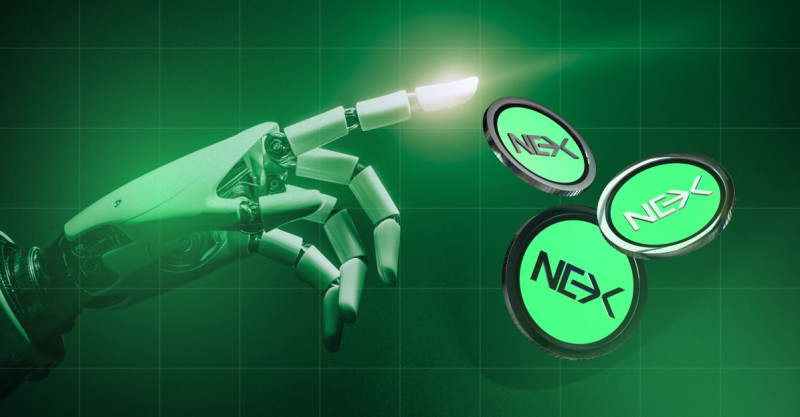
Nexchain was described as a layer-1 blockchain protocol that uses AI to optimize scalability, security, and interoperability. Its intended purpose was to address limitations associated with traditional blockchains, including limited scalability, insufficient security, and low adaptability. Its architecture combines a hybrid Proof-of-Stake model with AI. The AI dynamically adjusts transaction-processing parameters to support shorter validation times and higher performance without abandoning decentralization. The network uses sharding and directed acyclic graphs for parallel transaction execution.
NEAR is a layer-1 blockchain designed for scalability and user accessibility. It supports decentralized applications, including AI-powered applications, through sharding, developer tools, and an emphasis on usability. NEAR is used to pay transaction and storage fees, stake by validators, and participate in governance. A security article reported that NEAR was researching post-quantum migration, with a plan to integrate post-quantum cryptography into account infrastructure so users could rotate cryptographic schemes without moving assets to entirely new wallets.
Bittensor is a decentralized, open-source platform based on Proof of Intelligence consensus. It uses blockchain technology to coordinate the sharing of AI models and is intended to broaden participation in AI development. TAO rewards participants that contribute model training, data, or computing resources. The token is used to reward developers and data providers, support network security through staking, and participate in governance. The project's stated aim is to connect contributors to AI development through a decentralized network.
Token functions to compare across projects
- Transaction currency: paying fees for network operations, data storage, rendering, or service use
- Staking asset: securing a network, participating in consensus, or earning rewards
- Governance asset: voting on proposals and influencing project development
- Contributor reward: compensating model trainers, data providers, compute operators
- Access credential: providing access to AI models, SDKs, APIs, premium features
- Agent economy token: facilitating transactions between users and autonomous agents
Internet Computer and Render
Internet Computer hosts code and data and provides infrastructure for applications designed to withstand cyberattacks and high load. Applications mentioned include social networks, games, decentralized finance, registries, enterprise applications, and AI models. It unites independent data centers around the world and presents an alternative to centralized cloud hosting. The project was described as being led by Dominic Williams and as a subsidiary project of DFINITY.
Render is a decentralized GPU-rendering network that supplies computing power for graphics, machine learning, and other calculation-intensive work. Creators use RENDER to pay for rendering services, node operators earn RENDER for contributing GPU processing power, and token holders can participate in network governance.
AI Agent Tokens and Developer Tools
Virtuals Protocol was described as a platform for creating and deploying co-owned AI agents that can generate revenue. Agents can operate autonomously in virtual worlds, interact with users, and perform tasks. The tokenization model treats the NFT avatar as an asset that can increase in value as the agent develops. A market report described VIRTUAL as the largest token in the crypto AI-agent category at that time. The February list used the ticker VIRTUAL and provided figures showing a market capitalization of $754,104,413 with a circulating supply of 648,471,300.
ChainGPT is an AI assistant adapted to cryptocurrency users. Its stated capabilities include smart-contract generation, code auditing, token analysis, technical-document creation, and crypto-specific assistance through an interface similar to ChatGPT. The source reported implementation in wallets, exchanges, and decentralized-finance protocols. Its focus was positioned as making AI tools more accessible to crypto users, developers, and investors.
The Graph is a blockchain-data indexing protocol. It functions as a decentralized query layer that allows applications and AI systems to access and analyze blockchain data. Its indexing services can provide AI projects with efficient access to large on-chain datasets. GRT is used to pay for data queries, reward indexers that organize and supply data, and participate in governance.
If you follow crypto capital ventures , you may have noticed these projects attracting attention from funds investing in AI and Web3 infrastructure. Coinbase, a16z, and Binance Labs were identified as funds investing in AI and Web3 infrastructure. The source stated that projects with appropriate positioning could attract support, but it also treated technical review and diversification as necessary controls for the risk of loss.
One market report described VIRTUAL as the largest token in the crypto AI-agent category at that time, with a weekly gain of about 10%, while also noting that the token had not regained its earlier dominance.
Market Changes Affecting AI Crypto
A market snapshot reported that the total crypto AI-agent market capitalization had fallen by 65% in one month, from $20 billion to approximately $7 billion. The sector decline was uneven. Some tokens rose while others fell. At the same time, smart-account engagement was declining, though the rate of decline was beginning to slow.
The report noted that several AI tokens were launching on Base and Solana, while fewer were launching on Ethereum and BNB. It described this distribution as a possible foundation for renewed interest if AI-related narratives regained traction, while noting that the broader market remained under pressure.
DeFAI, which combines decentralized finance with AI, was described as the only crypto segment with positive month-to-month gains during that period. AGIX trading volume reached an average of $23.4 million per day, a 45% increase from the previous week. Binance AGIX/BTC volume was up 35% in 24 hours. Uniswap AGIX/ETH volume was up 20%. Active AGIX addresses were up 15% to 12,500. The RSI was 68 and the Moving Average Convergence Divergence showed a bullish crossover. The report used these indicators as evidence of renewed interest in AI and decentralized-finance activity.
How to Evaluate AI Crypto Coins
The evaluation should identify the chief executive and relevant technical leaders. Relevant experience includes projects that have progressed beyond the minimum viable product stage, academic work in AI, participation in developer or scientific conferences, and direct experience with the type of blockchain or AI system being built. I'd start here before looking at anything else.
A project's whitepaper should explain the architecture in understandable terms and describe the AI stack. Look for information about model training, data sets used for training, frequency of fine-tuning, protection against data poisoning, and how AI participates in network operations. The source also called for details on how external conditions influence adaptive contracts and whether claims about scalability, security, and decentralization are supported by implementation details.
The token should have a defined purpose. Possible functions include paying transaction fees, staking, governance, accessing AI models, paying for compute, rewarding data or model contributors, or using services within an AI ecosystem. A comparison should identify the specific problem being addressed, such as optimizing DeFi strategies, automating know-your-customer processes, generating models for a DAO, coordinating compute, indexing blockchain data, running autonomous agents, producing or distributing digital content, auditing code, or storing data for AI systems.
Key evaluation areas
- Team and expertise: check the chief executive and technical leaders
- Architecture and whitepaper: does it explain the AI stack clearly
- Use case and token necessity: what specific problem does it solve
- Product status and access: is there a working MVP or just documentation
- Open-source development: frequency of code commits, number of contributors
- Community activity: GitHub, Discord, Telegram, X discussions
- Token supply and distribution: circulating vs total supply, emissions, burns
- Security and audits: third-party audits, smart-contract vulnerabilities
- Privacy and data security: what data is collected, how it is validated
- Legal and regulatory status: securities, commodities, payments requirements
Security: Post-Quantum and Zero-Trust
AI is being used to accelerate quantum-computing research, which may shorten the timeline for quantum computers capable of breaking modern encryption. Experts remain divided on when such a computer will arrive. The broader concern is that AI could function as an attack tool, a defensive tool, and an accelerator of quantum research at the same time.
Experts described a "harvest now, decrypt later" security strategy. Governments and sophisticated actors may collect encrypted traffic now with the expectation that a future quantum computer will decrypt it. "Everything we're putting on the internet, if you're identifiable as a person of interest, you can assume will be decrypted in two years," one expert said.
Alex Pruden, CEO of Project Eleven, said: "The security landscape of the future is going to be different. Between quantum and AI, we're going to go into a world where security, and this is more broadly than just crypto, you simply cannot count on the way you've always done things."
A zero-trust security model assumes that risk persists and treats every request as potentially malicious. Wallet connections, token approvals, transactions, and other actions are continuously validated before execution. This approach is relevant because attackers can steal digital assets through impersonation, compromised endpoints, social engineering, and protocol manipulation. Although a decentralized architecture can reduce dependence on one central failure point, users still rely on devices, interfaces, remote-procedure-call endpoints, bridges, and other components.
Ethereum, Zcash, Solana, Ripple, and NEAR were identified as ecosystems actively researching or implementing post-quantum migration strategies. The transition remains technically difficult. Post-quantum cryptographic systems are often much larger and slower than current standards. "The cryptography that's currently standardized for post-quantum is very big and slow," one researcher noted. Both AI and quantum computing challenge the assumption that encrypted information will remain protected for long periods.
Mixers, privacy coins, and AI were also identified as technologies that can create new vectors for abuse. While privacy technologies and AI can have legitimate uses, they can also increase the surface area for fraud, sanctions evasion, unauthorized data use, or other abuse.

Token Functions and Supply
The token roles represented by these projects include transaction currency, staking asset, governance asset, contributor reward, access credential, agent economy token, incentive for shared ownership, and content and licensing asset. These functions should be compared separately from market capitalization. A high market capitalization does not establish that a token has utility, that a working product exists, or that the token captures value from the project's AI activity.
Token taxonomies are also important because tokens do not necessarily perform the same role. Organizations classifying or launching digital-asset projects may need to evaluate how each token contributes to finance, payments, enterprise systems, governance, access, or settlement, as well as the related technology, design, and regulatory implications. If you are researching best crypto to invest into , you should also look at token supply and distribution.
A comparison should determine why the token is needed and how demand is intended to develop. Review circulating and total supply, token distribution, emissions and burns, staking rewards, insider and team allocations, vesting and unlock schedules, governance rights, and mechanisms that connect token ownership to network use. A token used for governance, staking, service access, or network operation has a more explicit relationship to project activity than a token whose stated role is not explained.
Token supply and distribution checks
- Circulating vs total supply ratio
- Emissions and burn mechanisms
- Staking rewards and incentive structures
- Insider, team, foundation, or investor allocations
- Vesting and unlock schedules
- Governance rights and voting power
- Protection mechanisms against excessive supply growth
The source advised following the "do your own research" principle to reduce the risk of investing in a speculative or bubble-driven project. It did not present any review as a guarantee against loss.
Quick Reference
Market capitalization for AI cryptocurrencies can be found on CoinMarketCap and CoinGecko by filtering for the "AI" tag. AI cryptocurrencies most often use AI for decision-making, data analysis, process automation, and forecasting. Token Metrics, Messari, and ChatGPT can be used to help analyze AI crypto projects. The source advised using detailed and accurate prompts when doing so and verifying the resulting analysis against project materials.
If you're trying to figure out best crypto to buy , start with the basics: understand the token's purpose, check the team, review the whitepaper, and look at the product status. Don't skip the security audit part - this one's important, pay attention.
For those tracking top gaining crypto , remember that the AI crypto sector saw a 65% market-cap decline during one month. Uneven recovery is common, and past gains don't guarantee future results. The source noted that several AI tokens were launching on Base and Solana while fewer were launching on Ethereum and BNB.
A list of cryptocurrency coin is just a starting point. What matters more is whether the project has a working product, a clear use case, and a token that actually serves a purpose. A high market cap means nothing if the token doesn't capture value from the project's AI activity.
The source described the AI-crypto market as changing rapidly, with new projects continuing to emerge. Market rankings were presented as snapshots rather than exhaustive lists because of how fast the space moves.











Comments on “How to Compare Crypto Coins Built Around Artificial Intelligence”
No comments yet. Be the first to share your thoughts.