

What a Crypto Currency Is
A crypto currency is a digital asset built on blockchain technology that can be used for online payments, transferring value between people, or as an investment. The Charity Commission described cryptoassets as digital representations of value or rights that use blockchain for peer-to-peer exchanges. Bitcoin and Ether are the most well known examples. Some tokens are designed for payments, others for programmable applications, governance, or ownership records. The way a system is designed and used can determine how it gets classified and regulated.
How Blockchain Records Transactions
A blockchain is a shared, append-only digital ledger. Many computers participate in validating and recording transactions, making it a form of adversarial collaboration rather than control by one company. Once entries are widely shared, they become difficult to tamper with. The Charity Commission explainer described blockchain as extremely fast because information updates instantly, and immutable because past transactions cannot easily be falsified when copies are held across the network. No single organization has sole control of the shared ledger.
In early systems like Bitcoin, ownership is tied to a cryptographic private key. Only the holder of that key can authorize a transfer, similar to how control of cash depends on physical possession. Miners validate transactions in proof-of-work systems by solving hash-based puzzles. The successful miner records the block and earns cryptocurrency as a reward. This process requires substantial computation and has been characterized as more brute force than intellectual work.
The ledger is not easily overwritten, but this does not mean that every transaction has the same rules. A currency can be programmed to allow transfers, prohibit transfers, require authorization from another party, permit freezing, impose limits, or support other conditions.
Proof of Work Mining and Energy Use
Bitcoin's early proof-of-work system was designed for volunteers using personal computers. It made network voting power proportional to computing power, which helped keep the early network relatively decentralized. Modern Bitcoin mining has become a capital-intensive industry with data centers full of specialized ASIC hardware. A technical assessment from June 2022 argued this development removed many early decentralization benefits while consuming large quantities of coal and natural gas.
Matthew Green, a cryptographer at Johns Hopkins, made the environmental objection central to his defense of public blockchain technology. He cited an estimate that at least 60 percent of mining energy still came from fossil sources. A 2021 New York Times article compared Bitcoin's energy consumption with that of Finland. At the time of the 2022 assessment, Bitcoin was processing roughly 3.5 transactions per second worldwide. Green described the energy use as pointless, harmful, and quite possibly evil, particularly because the result might not be a highly decentralized network.
He viewed excessive proof-of-work energy use as a problem of the current implementation rather than an intrinsic, permanent feature of every public blockchain.
Proof of Stake and Other Consensus Methods
Proof-of-work is not the only method for building consensus. In a proof-of-stake system, voting power is tied to ownership of a valuable on-chain asset rather than electricity consumption and mining hardware. Green noted that proof of stake is not perfectly decentralized - token ownership can concentrate, giving richer holders greater influence. His narrower argument was that this concentration might still compare favorably with capital-intensive mining concentration.
At the time of the 2022 assessment, proof-of-stake systems were already in production in projects including Avalanche, Cardano, Algorand, and Tezos. Ethereum was rolling out a proof-of-stake upgrade then called Ethereum 2.0. Chia used proof of time and space, while other networks used more centralized proof-of-authority systems. These alternatives did not immediately solve the environmental problem since existing proof-of-work networks continued to consume energy.
Cash Like Transactions and Transaction Reversal
Bitcoin's original transaction rules were similar to cash. If one person sent money to another address, the recipient's private key controlled where it could go. There was no general undo function. Traditional debit cards, credit cards, and bank transfers operate differently - banks and card issuers are trusted parties that can reverse some fraudulent or mistaken transactions under specified conditions.
The technical assessment argued that ledger immutability does not determine whether a currency supports reversals. Reversal depends on transaction rules and the existence of a trusted party authorized to freeze accounts, destroy tokens, or issue replacements. Modern smart-contract systems, particularly on Ethereum, allow developers to define currency rules in many ways. A token can be programmed to prohibit transfers, freeze an address, require approval, or impose limits.
Regulated stablecoins with freeze controls
- USDC - issued by a licensed organization with centralized freeze capability
- Binance USD (BUSD) - regulated stablecoin with issuer-controlled minting and burning
- Both allow locking accounts of illegitimate recipients and compensating senders
- Regulators explicitly require this capability in some contexts
Compared with mature banking systems, stablecoin reversal systems were described as rudimentary. An issuer might not guarantee reimbursement of stolen funds, particularly if assets had already been transferred to a recipient who could not return them.
Transaction Throughput Fees and Scaling
The early Bitcoin protocol was not designed primarily for high speed or efficiency. In many cryptocurrency networks, every participating node validates every transaction. Adding more computing power does not automatically make the network process more transactions. At the time of the 2022 assessment, Bitcoin's worldwide transaction rate had historically topped out around seven transactions per second. Ethereum handled approximately 20 to 30 transactions per second. Visa was cited as processing about 1,700 transactions per second on an ordinary day.
Because demand could exceed limited network capacity, users competed for scarce space and transaction fees rose. One token transfer on Ethereum was cited as costing $22, while more complex decentralized-finance swaps could cost more. Green characterized this as making cryptocurrency unworkable for mainstream payments at the time of the assessment.
Scaling approaches
- Create more separate layer-one networks like Avalanche, Polygon, Celo, and Solana
- Layer-two rollups that process many transactions off-chain and place a compressed proof on the main chain
- Optimistic rollups using a trust and punish model with fraud proofs
- Zero-knowledge rollups using cryptographic proofs like SNARK or STARK
The assessment did not claim that scaling had been solved. Most current rollups focused on reducing computation. Layer-one nodes still had to store and transmit enough raw transaction data to reconstruct the rollup state. Vitalik Buterin was cited as estimating potential improvements on the order of 100 times for rollup servers, while also noting practical limitations.
Public Ledgers Pseudonyms and Privacy
Public blockchains require participants to verify transactions, which means transaction data is publicly visible. The source characterized older public chains as pseudonymous rather than anonymous. A user has an address instead of a printed legal name, but anyone can inspect the ledger. Sophisticated chain-analysis companies had made progress in linking addresses to real owners through transaction patterns, counterparties, timing, and exchange records.
Cryptographic privacy systems were described as a response. These systems can encrypt transaction details while using zero-knowledge proofs to show that encrypted amounts are consistent. Some deployed cryptocurrencies were described as providing strong privacy even against government surveillance. Privacy creates a policy conflict because financial systems must also address anti-money-laundering requirements.
Cryptographic systems could keep irrelevant information in the hands of users and disclose only what a verifier needed to know. The mature form of such systems was unknown at the time of the assessment.
Why Payments Matter
The technical defense of cryptocurrency was grounded partly in dissatisfaction with existing payment infrastructure. Credit-card merchant fees in the United States were described as similar to or higher than their levels in the 1990s. Because merchants generally pass those fees through to prices, they can affect consumers broadly, including lower-income households. The implementation of chip cards and tap-to-pay took nearly two decades in the United States. Online payment fraud was estimated at about $200 billion in 2020.
Pay-by-phone systems were already widespread in Kenya and China, while similar services in the United States remained underdeveloped and could give Apple or Google extensive control. Green argued that legacy financial institutions and regulators had created a mostly closed and permissioned system that could suppress two generations of payment innovation. He did not claim that blockchain was necessarily the solution - one possible outcome was that open blockchain systems would pressure traditional finance to produce better services.
The Development of Cryptocurrency Markets
Satoshi Nakamoto's Bitcoin paper was made public in October 2008, and Bitcoin was implemented as open-source software in January 2009. A market analysis published August 1, 2017 reported that Bitcoin's market capitalization exceeded $40 billion less than ten years after the project began. Ethereum was introduced in 2015, and its token Ether experienced an even faster rise in market price than Bitcoin. By 2017, Bitcoin and Ether were the leading cryptocurrencies by market capitalization and public attention.
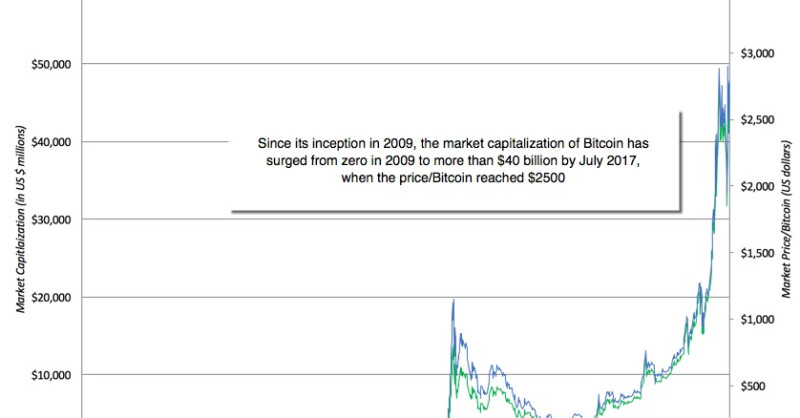
The market had also attracted many competing projects. Market success was evident from rising prices and public interest, but the analysis distinguished market success from success as a currency.
Three Functions of Currency
A currency is commonly evaluated against three functions. A unit of account provides a common way to value assets, liabilities, goods, and services. A medium of exchange makes transactions possible - it should be accessible, portable, and accepted by buyers and sellers. A store of value allows wealth to be held without losing purchasing power. Extreme price volatility makes this function difficult.
The three functions compared
- Unit of account - cryptocurrencies can satisfy fungibility, divisibility, and countability
- Medium of exchange - cryptocurrencies offer digital transfer and global reach but struggle with merchant acceptance
- Store of value - extreme volatility makes this difficult for ordinary users
The 2017 analysis found that cryptocurrencies were better able to function as units of account than as stores of value or media of exchange. Few retailers accepted Bitcoin. Overstock and Microsoft were cited as high-profile examples, but their acceptance was limited to selected items and often involved an intermediary converting Bitcoin into U.S. dollars.
Why Merchant Acceptance Has Been Limited
The sources identified several barriers to cryptocurrency payments. Inertia - people and retailers are accustomed to government-issued money, banking networks, cards, and payment apps. Price volatility - a merchant pricing goods in cryptocurrency would have to reset prices frequently, and a buyer would not know with certainty how many goods their crypto would purchase hours later. Competition among cryptocurrencies - buyers and sellers could hesitate before choosing one network. Design priorities - many creators focused on traders rather than people making transactions, optimizing around trading and price appreciation rather than payment utility.
Barriers to merchant adoption
- Inertia - switching costs for equipment, accounting, pricing, and consumer education
- Price volatility - unpredictable pricing discourages both merchants and customers
- Competition among cryptocurrencies - hesitation to commit to one network
- Design priorities - systems optimized for speculation rather than payments
The Gap Between Market Prices and Actual Use
An August 2017 analysis compared the rise in Bitcoin's price with the increase in Bitcoin transactions. Since the beginning of 2012, the price had increased more than one thousandfold, while the number of transactions in July 2017 was only about thirty-two times its level at the beginning of 2012. Three explanations were offered for this divergence.
First, forward-looking markets - investors may have been pricing expected future success as currencies. Second, speculative pricing - markets driven by mood and momentum rather than fundamentals. Third, loss of confidence in centralized authorities - some users might turn to Bitcoin for the same reason earlier users turned to gold during distrust of fiat money. The analysis argued that cryptocurrency assets would need to become less exciting as speculative investments if they were to become more widely accepted as currencies.
Characteristics of a Successful Digital Currency
The 2017 analysis proposed several characteristics for a cryptocurrency intended to compete with fiat money. Creators and proponents would need to emphasize transaction reliability, cost, speed, and usability rather than expected trading profits. Design choices such as supply caps would need to be justified by their effect on users and transactions. The analysis suggested that a successful currency might require compromises on privacy or centralized authority in some dimensions, since currencies still require trust - users have to trust the ledger, software, developers, exchanges, wallet providers, and legal protections.
Supply Caps Miner Rewards and Long Term Design
Cryptocurrency systems often issue new units as rewards for miners or validators. As a hard or flexible cap approaches, those rewards become less feasible. In Bitcoin, issuance can continue only within a predetermined schedule. In other systems, validator rewards may eventually depend on transaction fees. A currency faces a difficult transition - early users and validators can be rewarded while there is room for new issuance. Once the cap becomes binding, the network must continue operating through transaction fees or another reward mechanism. If fees become too high, ordinary payments become less practical.
Purchasing Power and Valuation
The August 2017 analysis used purchasing-power parity to frame cryptocurrency valuation. On August 1, 2017, Bitcoin was priced at approximately $2,775. The question was whether a buyer would be able to purchase $2,775 worth of goods and services with one Bitcoin. If Bitcoin became widely accepted and preserved purchasing power, its price could be supported by future utility. If it did not achieve widespread use, its high market price could depend primarily on speculation and momentum. This analysis concluded that Bitcoin and Ether had succeeded in attracting investors and public attention but had not yet succeeded as everyday currencies.
Arguments About Adoption Design and Alternative Systems
Several arguments in the wider debate offered additional explanations and possible uses. One participant argued that cryptocurrency adoption required more crypto-denominated liabilities - fiat currencies are widely used to pay taxes, debts, and rent, creating broad demand. Another suggested that Ether had an advantage because users needed Ether to run smart contracts on Ethereum. Commenters argued that cryptocurrency could serve people without access to conventional banking - immediate cross-border transfers, payments where local financial infrastructure is unreliable, access for people excluded from conventional systems, and direct transfers without a payment intermediary.
Alternative consensus and data structures
- IOTA using a Tangle structure designed for Internet-of-Things machine-to-machine transactions
- Chia using proof of time and space instead of proof of work
- Tokenized systems for real estate, art, supply chain tracing, and liquidity
- Golem and Siacoin combining cryptocurrency with shared computing resources
One commenter asked why a conventional database could not perform the same functions. A response distinguished an ownerless, distributed system from a database controlled by one organization - the distinction concerned governance and trust rather than a simple technical advantage. The discussion also noted that many financial-recording problems result from incorrect data entry or human judgment rather than alteration of records after entry.
Cryptocurrencies and Charities
Relatively few charities were using cryptoassets at the time of the 2022 Charity Commission analysis. Those that did generally applied them to limited purposes, such as moving currencies across borders where reliable regulated banking services were unavailable. Some charities accepted cryptocurrency donations but were likely to convert the assets immediately into regulated assets or traditional currencies. The Commission understood that only a very small number of charities held or traded cryptocurrency.
Trustees were advised to think carefully before investing, evaluate benefits and risks as they would any important decision, and obtain appropriate professional advice. Knowing the donor can be difficult in a cryptoasset transaction because blockchain systems are designed in some respects to provide anonymity or secrecy. That concern creates a tension between financial privacy and the need for trustees to understand the source of donated funds.
The Commission expected many trustees to remain cautious until more was known about the market and UK regulation. It described recent cryptocurrency price declines as reinforcing the need for prudence.
A Small Allocation Case Study
A January 2025 column by Francis Bayes examined why he described himself as winning with crypto despite not expecting it to materially change his path to financial independence. His investment thesis: some smart people will figure out some useful things with crypto, and he did not want fear of missing out to affect other aspects of his financial plan. He acknowledged the first half had not borne out as expected because apparently smart people had used crypto to scam others, but he continued to hold because he wanted FOMO to influence the rest of his plan.
Bayes's portfolio was 98 percent stocks in index funds and 2 percent cryptocurrency. He viewed a range of 1 to 5 percent as a possible sweet spot because crypto is volatile and has a relatively weak relationship with stocks. Stocks were rebalanced annually using new retirement-account contributions. Crypto was handled more actively - he bought when crypto fell to 0.8 times the target allocation and sold when it reached 1.25 times the target. Proceeds from sales went into stocks, while purchases used cash from a checking account.

Before 2024, the crypto allocation had a negative annualized real return. It lowered the portfolio's 2022 return by 1.05 percentage points, improved the 2023 return by 0.88 percentage points, and lowered the overall annualized real return from 2021 through 2023 by 0.09 percentage points. In 2024, the crypto position produced a 91 percent real return despite the sale of some Bitcoin for rebalancing. The allocation did not exceed 3 percent during the year. Crypto improved the total portfolio return by 1.29 percentage points. Bayes said he would be surprised if crypto continued outperforming at that rate as it matured.
Competing Views on Bitcoin as Currency and Investment
Reader debate sharply divided over whether Bitcoin should be understood primarily as currency, an investment asset, a scarce bearer asset, or speculative technology. Supporters described Bitcoin as digital scarcity with a fixed supply, global transferability, divisibility, 24-hour trading, and self-custody through private keys. Others stressed that Bitcoin was highly liquid but not widely accepted as payment. They identified complications including tax treatment, self-custody errors, poor user experience, loss of private keys, and the ability of governments or criminals to control a person through coercion.
A critic set out different criteria for an investment asset, arguing that traditional investments have identifiable sources of return - stocks produce earnings, bonds produce interest, real estate produces rent. Bitcoin does not directly produce rent, interest, or earnings. Another participant argued that Bitcoin should be treated like gold or another bearer asset where value comes from scarcity, portability, durability, divisibility, and the willingness of others to accept it. The debate produced differing market-size comparisons and historical return claims.
Key perspectives in the Bitcoin debate
- Digital scarcity with fixed supply and self-custody enabling independent function
- Highly liquid but not widely accepted for payments with tax and usability complications
- Investment asset lacking cash flows like earnings, interest, or rent
- Bearer asset like gold valued for scarcity and portability rather than yield
US Crypto Classification and Market Structure
A September 2025 analysis by Brad Lipton examined proposed United States legislation for cryptocurrency regulation. Congress was considering the second part of a planned three-part cryptocurrency framework. The first was the GENIUS Act, signed by President Donald Trump on July 18, 2025. A market-structure bill had already passed the House and was expected to be considered by the Senate. The proposed laws were described as creating a new federal framework. Lipton argued that weakening the framework could create regulatory loopholes in the wider capital market.
Market structure refers to how companies and assets are classified for regulatory purposes. Different rules and regulators apply depending on whether a company is offering securities, commodities, derivatives, payment services, or another type of financial product. A cryptocurrency can theoretically be used for payments, investment, speculation, or other purposes, so there was not one simple answer to which agency regulates every cryptocurrency product.
Securities and Commodities
Companies offering securities are regulated by the Securities and Exchange Commission under federal securities laws. Securities include stocks, bonds, and investment contracts. Companies offering commodities or related derivatives are generally regulated by the Commodity Futures Trading Commission. The Supreme Court's Howey case established the legal test for an investment contract. Bitcoin was the most prominent example of a cryptocurrency treated as a commodity rather than a security, since it was not cultivated by a particular company in the way securities typically are.
Some cryptocurrency companies accepted the classification and began complying with securities rules, commodity rules, or both. Crypto lobbyists sought to have crypto classified under the CFTC rather than the SEC. Security regulation is described as proactive and protective with mandatory disclosure, enforcement, and registration requirements. The CFTC relies more heavily on self-certification and often must establish wrongdoing before acting. The SEC was described as having between six and eight times the budget and staff of the CFTC.
Why Crypto Regulation Matters
The analysis reported that 17 percent of Americans had used cryptocurrency. Despite that minority share, cryptocurrency was beginning to enter retirement accounts and other conventional investment channels. The Trump administration was encouraging greater cryptocurrency investment in retirement savings, including 401(k) plans. Because retirement security could depend on crypto holdings, the source argued that investors must be able to distinguish assets that are genuinely regulated and secure from assets that only appear safe.
If crypto became an attractive fundraising method because it offered weaker protections, companies could abandon regulated stock and bond markets and use crypto instead. That could draw ordinary investors into an unregulated or less protected market through investments in conventional companies. The argument was that a weak crypto regime could therefore affect the financial system beyond the small group already using cryptocurrency.
Crypto Derivatives Leverage and Offshore Markets
A May 2026 analysis by Marco Dell'Erba and Andrea Vianelli examined crypto derivatives. They described crypto derivatives as structurally familiar but poorly governed - largely reproducing basic derivative structures like futures, options, and swaps in a faster, less transparent, and less regulated environment. The fragmented treatment was characterized as a policy failure rather than an inevitable consequence of the technology.
The most widely traded products were perpetual swaps, options, and quantos. Perpetual swaps are futures contracts without a fixed expiration date, allowing traders to maintain leveraged exposure without paying periodic rollover costs. Leverage of up to 125 times was described as common, and retail investors could access perpetual swaps directly without the safeguards applied to comparable products in traditional markets. The market expanded sharply between 2020 and 2023, with derivatives trading volume consistently exceeding spot-market volume. The market was highly concentrated, with Binance accounting for nearly 60 percent of trading volume.
The fragmented treatment of these products was characterized as a policy failure rather than an inevitable consequence of the technology.
Linear and Inverse Derivatives
Crypto derivatives were described as either linear/direct or inverse. Linear derivatives are margined and settled in fiat currency or stablecoins, providing exposure to the price of a crypto asset without automatically adding the risk of holding that crypto asset as collateral. Cash settlement makes linear contracts easier to fit within existing regulatory frameworks. Inverse derivatives are margined and settled in the underlying cryptocurrency, usually Bitcoin. The collateral's dollar value changes with the underlying asset, creating a convex effect that makes inverse contracts more dangerous than linear contracts at comparable nominal leverage.
Crypto settlement has been used to trigger exemptions in major jurisdictions including the European Union, the United Kingdom, Switzerland, and Hong Kong. As a result, economically similar or riskier crypto-settled products can face lighter oversight than cash-settled products. ESMA had begun clarifying that intervention measures apply to cash-settled perpetual swaps regardless of what the product calls itself, but the inverse-contract gap remained largely unaddressed.
Fragmented Regulation and Proposed Reforms
No jurisdiction had created a standalone legal category for crypto derivatives. Regulators instead tried to fit them into existing securities, commodities, derivatives, and payments frameworks with sharply varying results. Three differences were identified: settlement method, eligible underlyings, and listing and venue requirements. Liquidity moved toward offshore centers offering broad exemptions. Retail investors continued to access highly leveraged instruments in jurisdictions with limited oversight. Regulators lacked reliable information about market structure, counterparties, margin exposure, and total systemic risk.
Three proposed reforms
- A functional technology-neutral definition of crypto derivatives based on economic substance rather than formal labels
- Consistent reporting and prudential standards across settlement methods and listing status
- Meaningful retail restrictions on high-risk products comparable to restrictions on similar traditional products
The authors argued that this coordination should occur internationally because crypto-derivative markets are inherently cross-border. IOSCO was identified as an appropriate venue for harmonized standards. Without coordination, the analysis expected products to continue moving offshore, remain opaque, and reproduce regulatory failures seen in earlier derivatives cycles.













Comments on “What a Crypto Currency Is, How It Works, and Why It Matters to You”
No comments yet. Be the first to share your thoughts.