

What Is a Crypto DEX
A crypto DEX lets you swap tokens without a central exchange holding your funds. You trade directly from your wallet, and the smart contract handles the match. A decentralised cryptocurrency exchange removes the middleman, but it does not remove risk.
How DEX Pairs Work
At its core, a DEX pair combines two tokens you can trade against each other. A simple onchain swap is a user trading token A for token B. DEX trading platforms use various execution venues, which may be an automated market maker, an order-book DEX, or a request-for-quote system. Liquidity providers supply the assets and set the price. The trade settles onchain, and fees get split among the interface, the DEX, and the blockchain.
Four layers in a swap
- You pick two assets in a frontend or wallet
- The request routes to an execution venue
- Liquidity providers quote the price
- The trade settles onchain with fees
Centralized vs Decentralized
A 2025 analysis by Rutgers Law School professor Yuliya Guseva distinguishes crypto exchanges into centralized exchanges, or CEXs, and decentralized exchanges, or DEXs. Popular cryptocurrency exchanges like these bring buyers and sellers together, often on offchain order books, and frequently act as asset custodians. Different cryptocurrency exchanges serve different needs. DEXs run through smart contracts with automated execution and onchain transparency.
CEXs have faced criticism for insufficient transparency, market manipulation, conflicts of interest, insider trading, and weak governance.
DEXs remove some CEX-specific problems but create different risks. Smart-contract code can contain defects. Developers can retain governance influence. Validators and block builders affect transaction execution. MEV extraction can occur through front-running and back-running.
Quotes, Liquidity, and Slippage
A crypto data aggregator indexes blockchain data from multiple Web3 ecosystems. A DEX aggregator can compare liquidity and quotes for a pair like ETH/USDC across several DEXs and chains. It may calculate an aggregate price, find the best quote, and split a transaction among sources.
Liquidity aggregators gather liquidity from multiple venues. Interest-rate optimizers monitor lending rates across DeFi protocols. Slippage is the price movement between order preparation and execution. A slippage aggregator divides large transactions among sources to reduce impact.
A reliable aggregated price should reflect broad market coverage rather than one DEX quote.
Multi-Chain Indexing
A crypto data aggregation process has two parts: underlying data sources and an aggregation method. Raw price data may come from offchain CEXs or onchain DEXs. Before onchain data can be compared, it must be indexed. Blockchain networks make this hard because RPC interfaces, data formats, and smart-contract environments differ.
Analog describes Watch as a decentralized, blockchain-agnostic indexing platform. Its unified data model supports multi-chain indexing and normalizes data into a single representation called a View. A View functions as a custom API for indexing data from smart contracts.
Distribution and Value Capture
A Blockchain Capital research article by Jonah Burian examines why technical quality does not determine how much revenue a DEX retains. Value creation and value capture are separate concepts. A protocol can provide useful technology while other layers capture most of the economic value.
Onchain swap supply chain
- Frontend or wallet owns the user relationship
- Aggregator compares routes
- AMM, order-book DEX, or RFQ venue
- Liquidity providers and market makers
- Blockchain settles the trade
- Proposers and builders influence ordering
Users have many choices at each layer. A user may select the Uniswap interface and route into Uniswap pools on Ethereum, or use Jupiter on Solana with different execution venues. Frontends compete through brand and UX. Execution venues compete through liquidity and pricing. Blockchains compete through network effects and interoperability.
Vertical Integration
Early swap businesses attempted vertical integration by controlling both distribution and execution. The Uniswap interface sends flow directly into Uniswap's AMM. Consistent volume attracts market makers and liquidity providers. Some teams extend integration by launching their own application-specific blockchains, like Uniswap with Unichain.
Vertical integration can retain basis points that would otherwise flow to an external DEX. A standalone DEX can face a cold-start problem if it lacks dependable user flow. Liquidity attracts liquidity, but new providers may hesitate before reliable order flow exists.
Aggregators as Middle Layer
An aggregator sits between the user and multiple DEXs. It sends orders to the venue with the lowest quote, creating price competition. Aggregators outsource routing complexity while preserving frontend control of user experience. However, pure aggregators are middleware, not distribution. Frontends may switch aggregators for better rates or features.
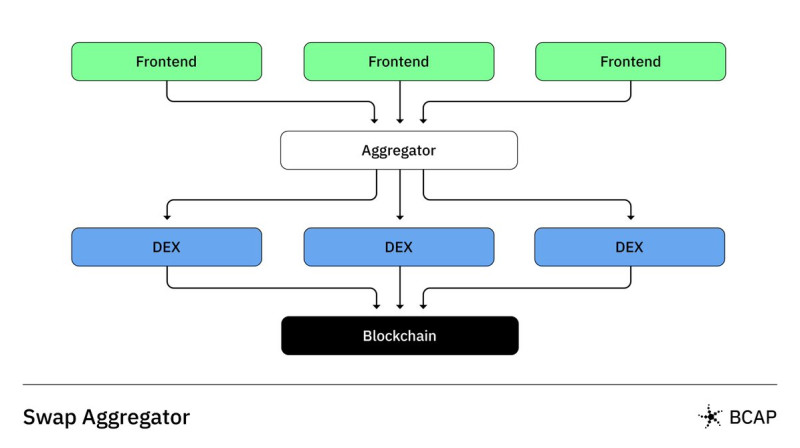
Some aggregators integrate both frontend and routing. This gives them reliable order flow and lets them pressure external DEXs with low fees. A further step is launching their own DEX at zero fees, which can commoditize competing venues.
An aggregator might send a trade to its own venue even when another venue has a lower quote. Traditional finance has best-price execution rules; onchain markets are less mature.
Wallets as First Gateway
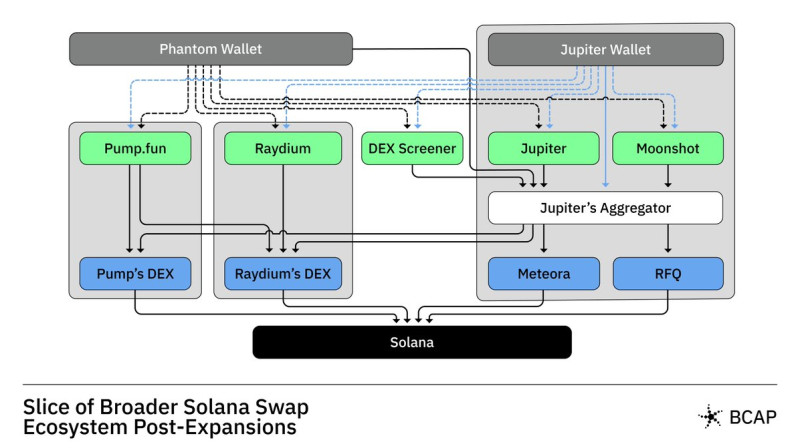
Wallets can become the first point of contact before a user opens a separate DEX frontend. Wallets like Phantom embed swap buttons directly in their apps. The wallet routes a swap through an aggregator or DEX without owning liquidity. This redirects user relationships and fees away from traditional frontends.
Solana Case Study
The Solana ecosystem illustrates the distribution pattern. Phantom controls the wallet layer and routes through Jupiter's aggregator. Pump.fun started as a memecoin launchpad directing users to external frontends. Raydium represents frontend and DEX vertical integration with its own interface and pools. Jupiter combines a user interface with routes from venues like Meteora and Raydium.
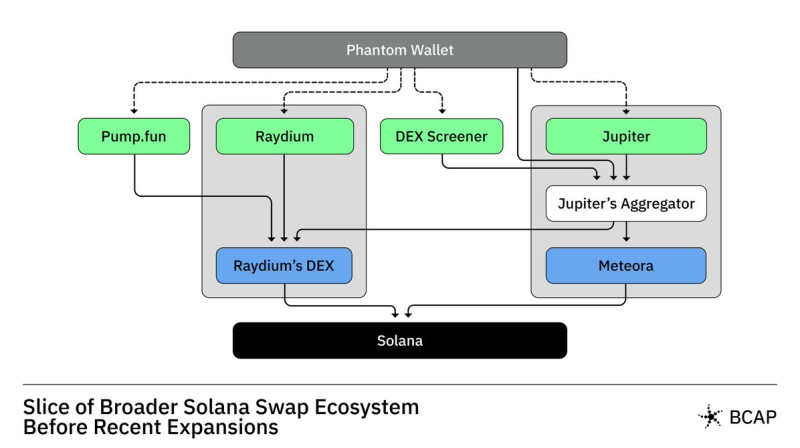
The chart ranks revenue rather than total fees because fee figures include liquidity-provider payouts. Raydium and Meteora generate large fee volumes for providers while retaining less net revenue. The analysis reports that Solana and DEX frontends rank among the largest revenue earners. Simple Telegram bots appear among top revenue generators, sometimes outranking technically complex protocols.
Market Participants Respond
Market participants in the Solana case study respond through vertical integration. Pump.fun added native swaps after routing volume to Raydium, then launched its own DEX. Jupiter announced a native wallet to capture more frontend layer. Jupiter acquired Moonshot, a Pump.fun competitor, to expand top-of-funnel reach. Jupiter also launched an RFQ engine for blue-chip trading.
Control over the first user gateway gives a platform flexibility to expand vertically, change routing, or pressure infrastructure providers.
Perpetual Swaps History
A perpetual swap is a derivative contract without a fixed expiration. Arthur Hayes's November 2025 essay gives a first-person history of the product. In May 2016, BitMEX had five people. OKCoin and Huobi controlled about 95% of crypto derivatives trading. BitMEX was distant third with thin liquidity.
The team wanted one product with no expiration so liquidity could concentrate in a single contract. The product was intended to resemble margin trading more closely. Hayes argues traders moving from margin trading to futures often found expiration dates confusing. A perpetual with a familiar format could reduce that complexity.

Perpetual Design and Funding
BitMEX launched its first XBTUSD perpetual swap in May 2016. Longs and shorts exchanged future cash flows based on a funding rate connected to USD and XBT. Funding initially updated daily. The margin system combined an insurance fund with a socialized-loss mechanism.
BitMEX delisted daily and monthly futures but retained quarterly contracts. Customer confusion increased. Funding rates were hard for users to understand. Hayes says his solution was a lookback index recording the perp's basis against spot, using a bounded portion as the next period's funding rate.
If the perp averaged a 1% premium over previous eight hours, a trader holding at funding would pay 1% to the short or receive 1% as the long. BitMEX automatically rebalanced profit and loss around funding timestamps and capped funding at the lower of the calculated rate, 75% of maintenance margin, or 0.5%.
Automatic Deleveraging
Automatic Deleveraging, or ADL, became the major subsequent change. BitMEX drew from Huobi's mechanism but added a ranking system and partial ADL. Under the Huobi implementation, traders could not estimate deleveraging probability and could lose their entire position. BitMEX introduced a visible indicator of deleveraging probability and allowed partial deleveraging.
BitMEX gradually phased out dated futures. Hayes says traders became comfortable with perpetuals. In late 2017, BitMEX reportedly overtook OKCoin as the most liquid derivatives exchange. By end of 2018, it was the largest global crypto exchange by volume.
Perpetual Markets Today
Hayes describes perps as solving two retail needs: leverage and liquidity. Retail access to high leverage is limited in many jurisdictions. Perpetual contracts provide a visible order book, unlike opaque CFD providers. He calls futures and perpetuals "delta one" because returns move one for one with the underlying asset.
Traditional clearinghouses support guaranteed settlement by pursuing defaulting participants through courts. Crypto assets are bearer assets held in wallets. A court can order a bank transfer but cannot compel a blockchain to send Bitcoin. Crypto margin systems rely on posted collateral and liquidation.
Hayes argues some traditional clearinghouses are undercollateralized. High crypto volatility and large open-interest positions could damage even large venues. He attributes part of this to capital requirements tied to guaranteed-settlement structures.
An Options Versus Perpetual Example: Nick Andrianov, Maelstrom head trader, compared a one-month Bitcoin call option against a highly leveraged perpetual. A 10% Bitcoin rise produced 3.1x return on the option but 10x return on the perp with 1% initial margin.
Perpetuals Outside Crypto
The essay says traditional firms previously treated perpetual crypto derivatives as unusual and excessively leveraged. SGX and CBOE were expected to launch perpetuals by end of 2025. Coinbase listed a retail perpetual earlier in the year. Hayes argues perpetuals can support weekend and overnight trading in markets that normally close.
In November 2025, he predicted equity perps would be a major 2026 product and that major exchanges would offer them by end of 2026. He expects price discovery for major US technology stocks to become more visible on retail perpetual markets. These statements are forecasts, not established outcomes.
Hyperliquid and Permissionless Markets
A November 2025 Hayes essay describes Hyperliquid as a fast-growing perpetual DEX. Its permissionless HIP-3 protocol lets qualified participants create markets using Hyperliquid's matching and margining engine. An early HIP-3 Nasdaq 100 equity perpetual traded more than $100 million per day.
A March 2026 BitMEX article develops a financial thesis around Hyperliquid and HYPE. It says Hyperliquid became the dominant perpetual DEX and largest revenue-generating crypto project other than a stablecoin. According to figures attributed to DefiLlama, 97% of Hyperliquid revenue was used to buy HYPE from the market.
The model starts with estimated revenue of $843 million in March and projects $1.4 billion by August. The target requires about 66% revenue growth. Hayes attributes most expected growth to HIP-3. Hyperliquid does not need the entire global perpetual market to grow. A 3.97% market share increase could move Hyperliquid to the $1.4 billion run rate.
HIP-3 permits permissionless perp listings. Participants must stake 500,000 HYPE to create markets. TradeXYZ used the protocol for perps tied to silver, gold, Nasdaq 100, and S&P 500.
Within four months, HIP-3 accounted for close to 10% of total Hyperliquid revenue. Hayes assumes HIP-3 revenue will rise 160% over six months. He presents precious metals, AI-related equities, and oil as products attracting retail traders.
Measuring Organic Volume
The article warns that reported exchange volume can be inflated. A "volumizer" can generate fake trades. Traders wash trade through coordinated wallets. Exchanges distribute tokens to encourage volume generation. None of these necessarily adds executable liquidity.
Open interest reflects capital committed to open positions. Average daily volume can be more easily inflated. The article uses ADV divided by OI as an approximate measure of volume associated with actual risk-taking. Under this framework, a lower ADV/OI ratio is better.
Hayes says Hyperliquid had the lowest ADV/OI ratio among top five perpetual DEXs and therefore the most credible volume. This is his analysis, and he acknowledges organic volume share cannot be known with certainty. He also compared order-book slippage for Bitcoin/USD perpetuals across five venues. Market buys and sells were tested with $100,000, $1 million, and $10 million sizes. Hyperliquid was least expensive for most trade sizes.
Token Distribution
The article describes Hyperliquid as an eleven-person team with no venture-capital funding. The team holds locked HYPE tokens. After distributing close to 20% in November and December, the team distributed about 1% in January and February. Hayes suggests early larger distributions may have reflected taxes and personal finance changes.
At the time, HYPE traded at approximately 12 times forward earnings. The article compares this with a 26-to-40 range for CME, Robinhood, and Coinbase. It attributes part of HYPE's lower multiple to smart-contract risk, counterparty risk, and the fact that many major spot CEXs do not list the token.
Hayes uses a target P/E of 25.2 in the principal $150 model. He also runs a downside scenario using a 12x multiple and a monthly team distribution of 9,910,000 HYPE. Under those assumptions, the target falls to $58, about 75% above a stated current price of $30. The article says HYPE reached an all-time high close to $60, then fell to a local low near $20.
Initial DEX Offerings
An initial DEX offering, or IDO, aggregates investment capital from individual investors. Token selection and listing are important because many DEXs do not vet assets the way a regulated CEX might. A decentralized market can expose users to fraud, worthless tokens, incomplete teams, or assets never listed on a CEX.
Launchpads like Pump.fun act as distribution funnels for new tokens. They expose tokens to initial audiences, seed liquidity on external DEXs, and later add native swaps. The evolution in the Solana case study shows how fundraising and token discovery connect to control over execution fees.
Security and Market Integrity
A DEX depends on smart contract quality and governance. A code defect can affect funds or trading. Governance concentration allows developers or token holders to change parameters users do not expect. Validators and block builders influence execution.
Liquidity can fragment across pools, protocols, and chains. A quoted price can move before execution, especially with large orders. Cross-chain routing adds bridge risk. A router may offer a high apparent rate while sending trade to a venue that is not the best after fees and slippage.
MEV refers to value block producers can influence through transaction ordering. Risks include front-running, back-running, sandwich attacks, builder strategies prioritizing higher fees, and order-flow auctions.
Some DEXs depend on external price data or oracles for settlement, borrowing, liquidation, or derivatives positions. If an external source is manipulated or compromised, the protocol uses an incorrect value. Onchain trades generally cannot be reversed after execution. A mistaken transfer, malicious contract, or manipulated transaction may leave no practical recourse. Can i buy crypto without id ? Users trade through pseudonymous wallets rather than KYC accounts, which raises this question.
Insider Trading Detection
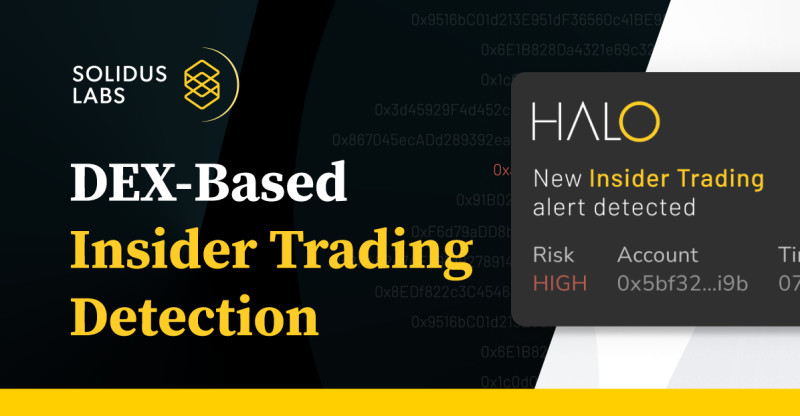
A May 2023 Solidus Labs announcement describes a tool for detecting potential insider trading on DEXs. The system compares trades in decentralized liquidity pools with a database of token listing events. It identifies addresses that may have traded based on material nonpublic information.
Solidus reports that since 2021, insiders used DEXs to buy tokens ahead of more than half of all major CEX ERC-20 listing announcements. Insiders used pseudonymous wallets and sometimes purchased tokens before those assets ever appeared on a centralized exchange. The proposed detection method does not establish wrongdoing by itself. It provides an onchain way to compare trading behavior with listing events.
Solidus founder Asaf Meir said: "Providing this level of transparency is a major step toward de-risking DeFi - allowing the industry and regulators to assess the true magnitude of insider trading in cryptocurrencies."
Regulation and Self-Regulation
Yuliya Guseva's proposed self-regulatory framework has two levels. First, CEXs would take on formal SRO functions: setting listing standards, implementing anti-manipulation controls, monitoring insider trading, and establishing fair execution rules. A CEX could register with FINRA or NFA, or as an individual SRO for digital assets.
Second, a policy-level SRO would oversee the broader digital-asset market. This organization would develop uniform standards, provide DEX developers with compliance resources, establish best practices, and maintain a whitelist of DEXs meeting requirements. The proposed policy SRO would improve information sharing among CEXs, DEXs, and other venues.
Barriers to Voluntary Regulation
Guseva identifies several barriers: voluntary compliance can be insufficient when incentives are misaligned. Competition among exchanges encourages weaker standards. Competition among jurisdictions creates regulatory arbitrage. Information and liquidity fragment across hundreds of platforms. Price formation is global, so events in unregulated venues affect regulated markets.
Rapid technological change, particularly when blockchain and AI combine, can outpace regulators' expertise. Critics of existing SROs cite capture by powerful participants, conflicts of interest, constitutional concerns, and under-enforcement. Guseva says a digital-asset SRO model would need independent governance, transparency, robust oversight, and room for decentralized operations.
US Regulatory History
The "Adapt or Die" essay gives a separate account of US regulatory developments. Hayes says he met CFTC representatives in Washington in 2018 to discuss applying for Designated Contract Market and Clearing Organization licenses. BitMEX would have used those licenses for perpetuals and socialized-loss margin in the US. Hayes says the CFTC later declined to receive the application.
He says the DOJ and CFTC indicted BitMEX more than two years later under the Bank Secrecy Act and Commodities Exchange Act. Hayes contrasts BitMEX's experience with what he describes as regulatory treatment of Sam Bankman-Fried and FTX. He says FTX made close to $100 million in political campaign donations and argues political connections helped FTX pursue a US license.
After FTX and Alameda collapsed, Hayes says US political and regulatory opposition to crypto intensified from late 2022 through early 2025. He links this shift to political support for institutions that had previously accepted crypto businesses. He says Trump's 2024 campaign raised hundreds of millions from crypto individuals and companies.
Hayes says once the United States began accepting perpetual products, other regulators followed. He cites SGX launching crypto-related perps after crypto became more acceptable to US regulators.
He predicts traditional exchanges will either add perpetual and socialized-loss products or lose market share. He further predicts that by 2029, a perpetual market for a major S&P 500 or Nasdaq 100 product could be larger than the equivalent CME market. These are Hayes's forecasts, presented as part of his argument that traditional finance will "adapt or die."












Comments on “How Crypto DEX Markets Work, Without Too Much Trading Jargon”
No comments yet. Be the first to share your thoughts.