
What Is a Cryptocurrency Mining Machine
A cryptocurrency mining machine is a computer or specialized device that supplies computing power to a blockchain network. Its processor, memory, storage, network connection, and cooling system work together to run mining software and perform hashing calculations. The machine may operate independently or join a mining pool with other computers. Think of it as renting your computer's processing power to participants on a cryptocurrency network. The network uses that power to validate and process transactions without a traditional bank or payment processor in the middle.
When you send bitcoin to a friend in London, Bitcoin miners around the world validate and propagate that transfer. Miners perform the processing work and receive compensation in cryptocurrency. That is the basic deal. The machine itself is still a computer. A general-purpose system can contain a CPU, motherboard, hard disk, power supply, network connection, and cooling equipment. Miners can also use graphics processors, application-specific integrated circuits, or other specialized components. The right components depend on the cryptocurrency algorithm, electricity cost, cooling requirements, scale of the operation, and desired hash rate.
How the Core Mining Process Works
Blockchain transactions must be validated and propagated across a network. Nodes validate transactions, while miners include validated transactions in blocks. Each block is cryptographically hashed and contains the hash of the previous block, creating the blockchain chain. Miners use computational resources to solve the block hash. As more blocks are mined, solving the hash becomes more resource-intensive.
A mining pool combines the computing power of multiple computers. The greater the computational resources harnessed by a pool, the greater its chance of mining a new block. When a block is mined, the pool's participants receive cryptocurrency rewards. In practical terms, the basic process consists of these steps: obtain suitable equipment, assemble and configure it, install mining software, connect to a cryptocurrency network or mining pool over the internet, perform hashing work, and pay the electricity consumed by the machine.
Technically, anyone can install mining software and start mining without asking a system owner for permission. That does not make every use of mining software legitimate.
Types of Mining Hardware
Graphics cards and central processing units can perform mining calculations, although a general-purpose laptop is unlikely to be profitable. In 2017, graphics cards were still widely used to mine cryptocurrency. The industry has largely moved toward machines designed specifically for mining, known as ASIC miners. Graphics cards can provide substantial hashing performance when configured for mining. CPU mining remains relevant for coins whose algorithms are designed to resist specialized ASIC hardware. Memory-hard algorithms are intended to make large amounts of dedicated hashing hardware less useful and can keep CPU or general-purpose hardware mining feasible.
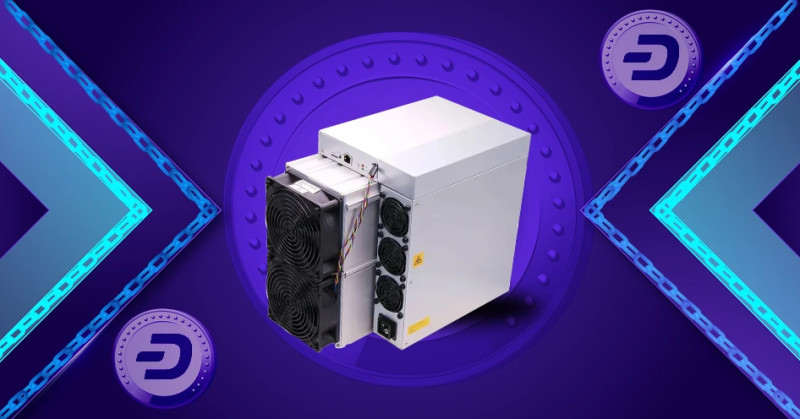
ASIC miners are built around chips designed for a particular algorithm or family of algorithms. A dedicated miner can provide high hash rate and energy efficiency, but it may have little value outside its supported coin or algorithm. A machine designed for Dash's X11 algorithm, for example, should not be treated as interchangeable with a machine designed for Bitcoin's SHA-256 algorithm or a memory-hard CPU-oriented coin. Mining machines also differ according to whether they merely contribute hash rate or validate an entire blockchain locally. A large node still needs fast, reliable storage.
Common mining hardware types
- CPU - general-purpose processor, feasible for memory-hard algorithms
- GPU - graphics card, substantial hashing performance when configured for mining
- ASIC - application-specific integrated circuit, built for one algorithm family
The Bitmain Antminer D9 Up Close
The Bitmain Antminer D9 is a dedicated Dash mining machine rated at 1.77 TH/s, also written as 1770 GH/s. Its stated specifications include a release date of February 2023, dimensions of 316 x 430 x 570 mm, weight of 16,200 g, noise level of 75 dB, four fans, power consumption of 2,839 W, Ethernet interface, operating temperature of 5 to 45 degrees Celsius, humidity of 5 to 95 percent, and the X11 algorithm. At 2,839 W, the D9 is a high-power machine. Its four fans and stated 75 dB noise level reflect the need to dissipate a large amount of heat. Profitability depends on hash rate, power consumption, electricity price, coin price, network difficulty, and operating costs. The 1.77 TH/s figure represents hashing capacity, not a guaranteed daily or monthly profit.
Dash Mining and the X11 Algorithm
Dash, written as DASH, is identified as the principal coin targeted by the Antminer D9. The D9 can also mine other cryptocurrencies that use X11, including MonetaryUnit, CannabisCoin, DigitalpriceClassic, Onix, and Axe. Dash is described as a cryptocurrency based on Bitcoin concepts and originating in the Latin American market. It includes features intended to support faster transfers, transaction privacy, and network security: Master Nodes, InstantSend, CoinJoin, PrivateSend, ChainLocks, and DAPI. Master Nodes can be used by depositing at least 1,000 DASH. The name was derived from "Digital Cash." Kyle Hagan is identified as the person who launched Dash Network. Businesses and organizations that had partnered with Dash or recognized it as a payment option include Bitrefill, Bitfy, Cloudbet, Coinpay, and NordVPN among others.
X11 applies a sequence of several different hash functions. Its stated purposes include improving transparency and security while producing a mining result that Dash and other compatible networks can verify. Dash mining difficulty measures how many hashes must be generated to find a valid solution for the next Dash block and earn its mining reward. Difficulty is plotted as a historical sequence of increases and decreases. Higher difficulty can reduce the reward or mining opportunity for a fixed amount of hash rate. A machine's actual revenue must therefore be checked against current coin prices, current difficulty, pool performance, electricity rates, and operating costs rather than inferred solely from its advertised hash rate.
A Personal Ethereum Mining Rig Story
A personal account published in 2021 described three friends building an Ethereum mining rig during the summer of 2017. The participants were the author, Captain, and Gamer. Captain hosted the project meetings, and Gamer supplied ideas and motivation. The rig was assembled in Captain's man cave. The project began as a personal experiment and as a possible way to earn money. The author had already invested in Bitcoin and Ethereum and understood mining conceptually but wanted direct experience. The group saw the project as a way to participate in a global financial network from Malaysia and to test whether they could build and operate a crypto mine themselves.
The rig was deliberately cost-optimized. Monitor, keyboard, and mouse choices were not expected to affect mining performance, so inexpensive or second-hand accessories were selected. A plastic shoe rack bought for RM 30 was modified instead of using a conventional computer enclosure. Graphics cards were treated as the exception. Two Nvidia GeForce GTX 1070 cards were purchased because the bulk of Ethereum mining at the time happened on graphics cards. The two GTX 1070 cards together cost more than three times the total cost of all the other components. The initial investment was RM 2,300 per person. The hardware was assembled on a Sunday afternoon, and the group used several additional evenings to configure mining software.

What Happened to That Rig
The original plan was to run the two-card machine, determine whether it was profitable, and then add more graphics cards. A mining profitability calculator estimated a one-year break-even period if cryptocurrency prices remained stable. Crypto prices crashed in 2018, and Ethereum did not recover until early 2021. The group therefore did not add more graphics cards. The two-card rig continued operating for more than two years. It was shut down in 2020 because electricity costs no longer produced a mining return. By then, publicly listed mining companies were operating large mining farms containing thousands of machines, reducing the competitive position of a small hobby rig. Higher electricity costs in Malaysia also made individual mining less profitable.
The three participants retained their mined Ethereum rather than repeatedly converting it. They used cash from other income to pay electricity bills and kept the Ethereum in their wallets. When Ethereum was later around $3,100, each participant had turned roughly RM 3,000, including electricity expenses, into more than RM 11,300. This was described as almost a fourfold increase, though buying Ethereum directly would have produced approximately a tenfold increase during the same period. The mining returns were also compared with the possibility of much larger cryptocurrency gains.
The account contrasts this industrial scale with an industrial use of otherwise wasted energy. It describes converting unused energy into digital assets as a potential opportunity for the energy sector.
Profitability, Electricity, Cooling, and Maintenance
Mining-machine economics can change faster than a hardware purchase. Relevant variables include coin price, mining difficulty, hash rate, power consumption, electricity price, pool performance, hardware purchase price, cooling costs, operating time and downtime, and maintenance and replacement expenses. Electricity cost is commonly measured in kilowatt-hours, or kWh. Malware researchers cited a test in which Coinhive ran on one machine for 24 hours and consumed 1.212 kWh. They estimated monthly costs based on that rate of $10.50 in the United States, $5.45 in Singapore, and $12.30 in Germany. Actual costs would vary with local tariffs, runtime, thread use, and the number of infected machines.
Cooling is a direct hardware requirement because sustained high-power hashing produces substantial heat. The Antminer D9's 2,839 W rating, 75 dB noise level, and fans illustrate the physical infrastructure required for a high-rate X11 machine. Cooling must be adequate both for the device and for the room in which it operates. Malicious mining can also overload a processor or operating system. In an extreme case, CPU overload may cause the system to crash. A machine can also become a source for further malware or an infection path to other hosts, increasing network traffic as the malware copies itself or launches payloads.
Mining Pools, Full Ledgers, and Storage Performance
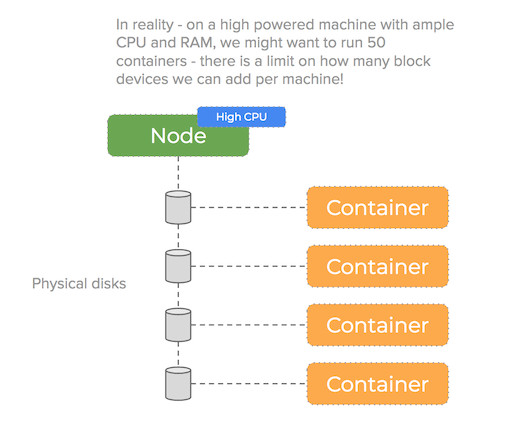
Mining is competitive because thousands of computers attempt to win the reward for the next block. Because proof-of-work algorithms are computationally intensive, more useful performance can increase the chance of finding the winning hash. At a large scale, even a small bottleneck can prevent a node from performing at its potential. A cryptocurrency node needs compute, network, and storage resources. Blockchain clients are stateful: they retain a copy of the ledger, and each node or container may need a large writable copy. In December 2017, the Bitcoin ledger was stated to be 149 GB and was expected to continue growing as payments and adoption increased. A full local copy creates storage requirements.
Network file storage such as NFS was described as unsuitable when every read and write affects mining performance. Blockchain applications require fast I/O, so spinning disks and network-based disks can introduce latency. The storage performance guidance identifies these options: use SSD rather than spinning disks, keep disks local to the compute node to reduce read and write latency, do not allocate an entire disk to every container when higher container density is required, use a performant cloud-native software-defined storage layer, use a dedicated SSD or NVMe device for filesystem metadata or journal data when the storage provider supports it, select an I/O profile appropriate for the application, and place compute workloads on the same host as the blockchain ledger, an arrangement described as hyper-convergence.
Storage tips for mining nodes
- Use SSD rather than spinning disks
- Keep disks local to the compute node
- Use a cloud-native software-defined storage layer
- Consider a dedicated journal device for metadata
Portworx Software-Defined Storage
Portworx is described as a cloud-native software-defined storage solution that integrates with Docker and Kubernetes. It manages underlying disks and presents storage to containers. Its cluster-aware design can use one storage system across potentially thousands of nodes. It creates a storage pool from underlying disks and can manage those disks across the cluster. Decoupling storage from individual containers allows more containers to run on one compute host without giving each container a full physical disk. A filesystem turns a sequence of bytes on a block device into files and folders. Journaling filesystems also write metadata, or journal data, so the filesystem can recover after a failure such as a power loss. If data and metadata use the same block device, both operations compete for the same I/O operations per second, or IOPS. Some filesystems support a second block device for the journal, allowing data and metadata to use more available IOPS. Portworx supports a second block device as its journal device. When added across a cluster, the approach increases the IOPS presented to the node's container volumes.
Legitimate Cloud Mining on AWS
AWS requires written approval for cryptocurrency mining under Section 1.25 of the AWS Service Terms. AWS Trust & Safety reviews requests to reduce the risk that mining will adversely affect service performance or infrastructure security. A mining request should include the purpose of the mining and its business case, infrastructure plans, cost-management plans, security measures intended to prevent unauthorized access, emergency contacts, and the number and type of instances used for mining. After approval, the operation must remain within the prescribed architecture and security practices. AWS monitors approved mining for abuse reports, service-performance effects, and deviations from the approved design. AWS Credits and Free Tier resources cannot be used for cryptocurrency mining. Approved operations must be monitored continuously. AWS may change its approval decision as infrastructure conditions change.
Why Attackers Target Mining Resources
Cybercriminals favor cryptocurrency because it offers a degree of anonymity and can be monetized relatively easily. Their interest extends beyond purchasing illicit goods and services. Operations observed around cryptocurrencies include malicious cryptocurrency mining (cryptojacking), theft of cryptocurrency wallet credentials, extortion, targeting cryptocurrency exchanges, and abuse of unauthorized cloud and endpoint capacity. Cryptojacking allows an attacker to use processing power without purchasing the mining infrastructure. The reward goes to a wallet controlled by the attacker or malware operator.
The cost of unauthorized mining includes performance degradation, electricity consumption, and exposure of additional security weaknesses. High CPU use can slow or crash systems. Mining malware may consume network capacity while spreading to neighboring hosts. On operational technology networks, even modest additional load can be significant because SCADA and industrial-control systems may depend on older hardware and low-bandwidth networks. A delay can impede an operator's ability to interact with a controlled process in real time. A cryptomining compromise can reveal a broader breach. The initial access may provide credentials, backdoors, or lateral movement that can later be used for ransomware, data theft, or industrial-control malware.
Intrusions are sometimes discovered only after charges accrue or legitimate workloads slow down. Attackers can deliberately target resources already expected to have high compute use and can use mining software to keep systems busy.
Monero and the Criminal Miner Ecosystem
Much of the 2018-era cryptojacking activity focused on Monero. Monero is based on the CryptoNote protocol and was described as a fork of Bytecoin. It uses ring signatures, which shuffle users' public keys to make a particular user harder to identify. It can also generate multiple single-use addresses associated only with the intended recipient, making transaction linking more difficult. Monero used the CryptoNight memory-hard hashing algorithm rather than Bitcoin's SHA-256 algorithm. The report characterized CryptoNight as deterring ASIC mining and preserving the viability of CPU mining. Those privacy characteristics and CPU compatibility made Monero attractive for unauthorized cryptojacking.
Most miner utilities are small, open-source tools. Criminal sellers therefore often wrapped them in crypters that used encryption, obfuscation, and code manipulation to make malware fully undetectable, or FUD. Frequently observed Monero miner names included XMR Mining Utilities, XMR-Stack, MinerGate, XMRMiner, ccMiner, XMRig, Claymore, SGminer, Cast XMR, LukMiner, and cpuminer-multi. FireEye iSIGHT Intelligence found underground interest in cryptocurrency mining topics dating back to at least 2009. High-volume search terms included miner, cryptonight, stratum, xmrig, and cpuminer. Mentions of mining-related terms increased sharply beginning in 2017.
Underground Miner Sales
In early April 2018, an actor using the name Mon£y was observed selling a Monero miner for $80 called Monero Madness. It included unlimited builds, automatic updates, 24/7 support, a builder interface, AutoIT code with no external dependencies, FUD, safer error handling, recent XMRig code, customizable pools and ports, UPX packing, support for 32-bit and 64-bit Windows, and a "Madness Mode" that started mining only after the infected machine had been idle for at least 60 seconds. The idle setting was intended to let the miner use available processing power without running while the victim actively used the computer.
In March 2018, an actor using the name kent9876 advertised a CPU or GPU Monero miner called Goldig Miner. The CPU-only or GPU-only version cost $23, while both builds cost $50. It was advertised with C and C++ code, a build size of approximately 100 to 150 kB, concealment from common task managers, operation without administrator privileges, automatic updates, data encoded with a 256-bit key, access to a Telegram bot builder, and 24/7 support through Telegram. In March 2018, the actor TH3FR3D offered a C# tool called Felix for $50 payable in Bitcoin or Ether. Felix combined a credential stealer with a Monero miner. In January 2018, an actor using the name ups sold a Windows or Linux miner for multiple CryptoNight currencies. In August 2017, an actor named MeatyBanana sold a CPU-only Monero miner for $30 payable in Bitcoin.
The Cost of Cryptojacking
Unauthorized mining creates costs on three levels: reduced system performance, increased electricity use, and exposure of security weaknesses. Cryptomining malware can drive CPU load high enough to make applications unusable or crash an operating system. Infected devices may also spread to neighboring systems and produce enough traffic to overload a local network. Electricity use depends on how often the miner runs, how many threads it uses, how many devices are infected, and local electricity rates. The reported Coinhive test consumed 1.212 kWh over 24 hours, with estimated monthly electrical costs of $10.50 in the United States, $5.45 in Singapore, and $12.30 in Germany. Mining malware can expose weaknesses that permit more damaging attacks. Systems compromised for cryptomining may also be exposed to ransomware, credential theft, data theft, or industrial-control malware.
Cryptojacking cost breakdown
- Reduced system performance - high CPU load slows or crashes applications
- Increased electricity use - depends on runtime, threads, infected devices, local rates
- Exposure of security weaknesses - opens door to ransomware, credential theft, data theft
Victim Demographics and Cloud Cryptojacking
FireEye detection data showed a significant increase in cryptocurrency-miner malware detections beginning in 2018. MinerGate and NanoPool were the most commonly observed pools. The United States was the most affected country, while the education sector was the most affected industry. The education-sector result was attributed to relatively relaxed security controls on some university networks and students' access to electricity while studying. Cloud systems attract cryptojacking because they offer substantial processing capacity. Cloud customers already expect some CPU use and electricity costs, which can make malicious activity less obvious.
Examples of cloud cryptojacking described in 2018 reporting included FireEye research on Oracle server exploitation through CVE-2017-10271, cryptomining campaigns targeting vulnerable Docker and Kubernetes deployments, a Tesla breach in which attackers found an unprotected Kubernetes console and used access to the AWS environment to mine Monero, and misconfigured AWS S3 buckets that allowed internet users to read or alter hosted content. The LA Times was cited as a February 2018 example in which an attacker could inject mining scripts or other malicious content.
Cryptojacking in Botnets, Browsers, and Mobile Devices
Modular botnets can add a mining module with little additional infrastructure. FireEye iSIGHT Intelligence identified mining modules in prominent botnets including Dridex and Trickbot. Even if an infected machine has little monetary value for credential theft, its compute can still produce mining income. Browser mining scripts can use a visitor's CPU while the page is open. Scripts have appeared on compromised websites, third-party advertising platforms, and sites where publishers intentionally authorized them. At the time of the 2018 report, Coinhive was the most widely deployed browser-mining script. It is an open-source JavaScript library that can mine Monero with a visitor's CPU resources. Examples included the SafeBrowse Chrome extension embedding Coinhive to mine Monero without user consent, a Coinhive script in the footer of The Pirate Bay torrent site, and Coinhive embedded on the Showtime and LA Times domains.
Most browser mining stopped when the browser was closed. Malwarebytes researchers identified a technique that used a pop-under window hidden under the taskbar to keep mining after the visible browser window was closed. Malicious advertisements on legitimate websites can redirect visitors to exploit-kit landing pages. Those pages scan for vulnerabilities, exploit them, and download malicious code. Mobile cryptojacking was less common because mobile devices provide less processing power than servers and desktops. It remains a risk because sustained power consumption can shorten battery life, generate heat, or physically damage a device. Examples included CoinKrypt, Android.Trojan.MuchSad.A, BadLepricon, Android Slave, Loapi, and nineteen Google Play applications reported by SophosLabs in January 2018 that contained Coinhive-based code.
Spam, Worms, and Proxy-Based Detection Avoidance
Cryptocurrency miners have also been distributed through spam. A late November 2017 campaign used a PDF attachment designed to resemble an invoice from Lyttelton Port of Christchurch. When opened, the PDF launched a PowerShell script that downloaded a Monero miner. A January 2018 campaign used financial-service-themed email messages with links delivering a ZIP archive containing a Monero miner configured to use the MinerGate pool. Self-propagating mining malware can create larger pools of compromised CPU resources. Observed methods included copying to removable drives, brute-forcing SSH credentials, and using the leaked EternalBlue exploit. In May 2017, Proofpoint reported the Adylkuzz campaign which used EternalBlue to spread across corporate LANs and wireless networks.
Mining proxies can avoid developer and commission fees of 30 percent or more. They can also reduce the number of active mining-pool connections. Examples included XMRig Proxy and CoinHive Stratum Mining Proxy. Actors may avoid common services such as Coinhive, CryptLoot, and DeepMiner, host mining code on their own infrastructure, and use private servers or Node.js-capable cloud servers. This can make domain- and filename-based blocking more difficult. Actor-controlled cloud hosting was described as offering free or low-cost capacity, no server maintenance beyond uploading the application, resilience when the host address cannot be blocked without affecting legitimate services, and easier replacement through disposable hosting accounts after takedown.
Linux Cryptocurrency-Miner Competition
By 2020, the market capitalization of cryptocurrencies was described as exceeding $350 billion. Attackers targeted powerful devices to obtain more mining revenue, sometimes killed competing miners, and expanded their targets into Docker, Redis, AWS, Kubernetes, and other cloud infrastructure. A more recent pattern was a post-infection routine that detected other mining malware, killed competing processes, deleted traces, and attempted to prevent the competitors from running again. The malware did not limit competition searches to host processes. It also looked for Docker containers running miners so the newly installed malware could gain access to the host's compute capacity.
Earlier campaigns often exploited a vulnerability in a publicly hosted service to obtain code execution, create a botnet, or install a miner. The newer pattern examined in 2020 searched for exposed APIs on Docker, Redis, and similar platforms. After finding a weakness, the malware could deploy a shell script, a malicious container, or a legitimate container with a malicious shell script. The initial script performed environment analysis, scanned running processes, found competing miners and security software, and killed or removed them. It could use ps, kill, and rm to remove cryptocurrency miners and legitimate resource-intensive applications. The script then downloaded miner binaries and related malware. It removed command history and logs to conceal the infection.
Three analyzed samples contained three unique Monero wallets. At a Monero value of $90, the samples had generated approximately $777 as of September 3, 2020.
Azure Linux Coin-Miner Attack Scripts
Azure research published in 2020 described an attack that several customers had observed. Unlike attacks focused primarily on guessing passwords, this campaign exploited an internet-facing service to execute the attacker's code on the host. The attacker used echoed base64 scripts, allowing researchers to see intended actions as well as executed activity. The first suspicious audited-log entry had the pattern: echo BASE64_ENCODED_COMMAND | base64 -d | bash. The parent process was an application or service exposed to the internet. Accounts seen in these attacks included customer-specific accounts and common service accounts such as Ubuntu, Jenkins, and Hadoop.
Most of the attacker's work was performed through base64-encoded scripts. The scripts commonly began by redirecting standard output and standard error to /dev/null and extending the path to standard system-command directories. The scripts also contained loops that tried multiple onion and Tor-related domain names. More than 30 encoded scripts were observed across customers, but they reduced to approximately 12 basic variants with differences in executable names or download locations. The attack scripts searched.bash_history, /etc/hosts, and ~/.ssh/known_hosts for IP addresses. They attempted to pass the initial encoded payload to discovered systems through both root and the account compromised on the current host.
Dexphot and Rarog Cryptomining Malware
A December 2019 Proofpoint article described Dexphot as a cryptomining Trojan and a second-stage payload. Microsoft reported that Dexphot had infected more than 80,000 machines from its discovery in October 2018 through its peak in June 2019. Dexphot commonly operated as a second-stage payload after ICLoader and other software-install malware. It was associated with fileless execution, polymorphism, hiding in normal Windows processes, smart and redundant boot-persistence mechanisms, changes to file names and mining URLs every 20 to 30 minutes, and an installer written to disk only briefly.
Unit 42 published the Rarog analysis on April 4, 2018. Rarog had been sold in underground forums since June 2017. By the time of the analysis, approximately 2,500 unique Rarog samples had been observed. They communicated with 161 command-and-control servers. More than 166,000 Rarog infections were confirmed worldwide, with especially high concentrations in the Philippines, Russia, and Indonesia. Rarog primarily mined Monero but could mine other currencies. Its features included configurable mining parameters, mining statistics, configurable processor load, USB-device infection, loading additional DLLs, persistence through a Run registry key, scheduled tasks, startup-folder shortcuts, downloading and executing other malware, DDoS functionality, and Trojan updates. The broad Rarog activity produced little recorded profit. One description placed the highest observed profit at roughly $120.

Detecting Mining Activity
Mining-pool clients commonly use the Stratum protocol over TCP or HTTP/S. Stratum uses a publish/subscribe structure. Clients send subscription requests, and the server publishes messages to subscribed clients. The messages are readable JSON-RPC messages containing fields such as id, method, and params. A deep packet inspection engine can look for these fields and block unencrypted Stratum mining over TCP. JavaScript miners that use Stratum over HTTPS are more difficult to inspect when the security system does not decrypt TLS traffic. Organizations can block known pool IP addresses and domains, but maintaining a complete pool blocklist is difficult because pools and infrastructure change.
General indicators of mining activity include connections to unknown IP addresses, mining-pool ports such as 3333, sustained CPU or GPU use inconsistent with normal workloads, sudden network traffic to unfamiliar addresses, unfamiliar or unauthorized processes, connections to cryptocurrency domains, direct communication with crypto-related IP addresses, Lambda functions contacting mining pools, miner processes inside containers, unexpected services or scheduled tasks, and coin-mining binaries or configuration files. Browser mining can be addressed by blocking domains known to host mining scripts, blocking known mining-project sites such as Coinhive, blocking scripts, using ad blockers or mining-specific browser extensions, detecting common miner file names and script patterns, and alerting on and blocking traffic to known mining pools. JavaScript running in a browser cannot directly access files on disk. If a user visited a site containing mining scripts, clearing the browser cache and other browser data was recommended.
General indicators of mining activity
- Connections to unknown IP addresses or mining-pool ports like 3333
- Sustained CPU or GPU use inconsistent with normal workloads
- Sudden network traffic to unfamiliar addresses
- Unfamiliar or unauthorized processes
- Connections to cryptocurrency domains or crypto-related IP addresses
- Lambda functions contacting mining pools
- Miner processes inside containers
- Unexpected services or scheduled tasks
- Coin-mining binaries or configuration files
Layered Defensive Controls
The security controls identified across the mining-machine and cryptojacking material include identity and access controls like least-privilege permissions, multi-factor authentication, centralized identity management, short-lived or role-based access, IAM Roles Anywhere instead of long-lived external keys, regular key rotation, regular IAM permission audits, just-in-time access, passwordless authentication, strong credential management, changes to default passwords, and restricted administrative accounts. System and service maintenance includes regular patching, current operating-system images and AMIs, patch testing before production deployment, removal of unused services, verification of Docker and Redis configuration, API exposure reviews, open-port scans, restricted SSH access, security extensions and approved platform settings, inventory of installed applications, and detection of unauthorized miner binaries.
Network controls include restrictive ingress rules, egress filtering, granular outbound filtering, blocking of known mining infrastructure, DNS monitoring, network firewall deployment, alerts on traffic to unfamiliar addresses, protection against connections to Tor and onion networks, and monitoring of DNS, VPC Flow Logs, CloudTrail, and workload telemetry. Endpoint and runtime controls include endpoint protection, antivirus capable of detecting cryptominers, runtime monitoring, process monitoring, file-integrity monitoring, alerts on unfamiliar processes, unexpected-service detection, container and EKS protection, scans for cryptocurrency-mining software, and automated termination of unauthorized workloads. Browser and email controls include web filtering, current browser extensions, ad blocking, mining-specific browser extensions, blocking of known infected websites, monitoring of legitimate browser extensions, phishing awareness, suspicious attachment and script warnings, and filtering of cryptocurrency-themed spam and malicious attachments.
Cloud controls include GuardDuty across all accounts and Regions, Runtime Monitoring, EKS protection, CloudWatch alarms for CPU, GPU, and network use, AWS Config compliance checks, IMDSv2 enforcement, Systems Manager inventory and policy enforcement, EventBridge and Lambda response workflows, encryption with AWS KMS, TLS for data in transit, encryption-key rotation, continuous monitoring of approved mining, and written approval before mining on AWS. For Linux servers and containers, the identified controls were least privilege, prompt patching and updates, multi-factor authentication, verified security extensions, access-control policies, Docker and Redis security guidance, API configuration reviews, host or internal-network validation for API requests, regular open-port scans, limited SSH access, runtime scanning of hosts and container images, and cloud and hybrid-workload monitoring.

If you're wondering how does mining crypto work or how does crypto miner work , the answer comes down to computing power doing hash calculations for a blockchain network. People asking how can i mine cryptocurrency or how do i mine for cryptocurrency should know that legitimate mining uses your own authorized hardware. The best crypto mining software depends on your hardware and target coin. Before chasing the most profitable crypto to mine , factor in electricity, cooling, and hardware costs. The best crypto coins to mine change as difficulty and prices shift. And if you're exploring apps to mine cryptocurrency on a phone, understand the returns are tiny compared to the battery wear. What does mine cryptocurrency mean in practice? It means your machine does math, the network gets security, and you get coins - if the economics work out.

















Comments on “How Cryptocurrency Mining Machines Work and Why Attackers Target Them”
No comments yet. Be the first to share your thoughts.